

Choose plain automation (rules, scripts or robotic process automation) when a job follows the same steps every time and its inputs arrive in a predictable shape. It’s cheaper, faster and does exactly what you told it. Choose an AI agent when the inputs vary, the next step depends on reading the situation, or the job needs a judgment call your own data can support. Most real jobs are both: rules carry the routine steps, an agent makes the one call that needs reading, and a person signs off on the exceptions.
So the first question in AI vs automation isn’t which tool to buy. It’s where your job varies. Even the company that builds the models agrees. In its guide to building effective agents, the AI lab Anthropic recommends “finding the simplest solution possible”, and adds that this “might mean not building agentic systems at all.” If you run a company of 50 to 500 people, that’s the test to apply before anyone quotes you an agent.
What’s the difference between AI and automation?
Automation follows steps someone wrote down: if this happens, do that. An AI agent is given a goal and works out its own steps toward it. One runs a fixed path; the other chooses its path as it goes.
Anthropic draws the same line. In its terms, a workflow runs AI and tools along code paths set in advance, while an agent directs its own process and decides which tools to use.
Think of a recipe card in a restaurant kitchen. A line cook follows it the same way every night, and the dish comes out the same. Now tell a cook, “Dinner for twelve tonight, and one guest is gluten-free.” There’s no card for that. The cook has to work out the steps. Automation is the recipe card. An agent is the cook who works out the steps.
Both have a place. Part 1 of this series covered the jobs an AI agent can take on; this part is about the jobs it shouldn’t.
AI vs automation: how do agents and rules compare?
Plain automation wins on cost, speed and predictability. An AI agent wins when the inputs are messy or the steps can’t be known in advance. Here’s how they compare on what a buyer actually weighs.
| Plain automation (rules, RPA) | AI agent | Verdict | |
|---|---|---|---|
| Best for | The same steps every time | Steps that depend on the situation | Match the tool to how much the job varies |
| Inputs | Structured and predictable | Messy and varied: emails, PDFs, workbooks no two alike | Messy inputs need an agent |
| Predictability | Does exactly what it’s told | Can reason its way to a different answer, right or wrong | Rules, when a silent mistake is costly |
| Speed and running cost | Fast and cheap per run | Slower, and costs more per run | Rules, unless the job needs reading |
| When things change | Breaks on a new form or screen until someone edits it | Adapts to small changes; needs checks to catch drift | Agent, where change is constant |
| Checking the work | Logs show every step | Needs review points and a person on exceptions | Rules are easier to audit |
| Typical jobs | Routing, copying data between systems, reminders, reports | Reading documents, triage, a first-pass judgment | Most jobs need some of each |
When is plain automation the better buy?
Plain automation is the better buy when the steps never vary, the inputs arrive in a fixed format, and a mistake must never slip through silently. Moving invoices from one system to another, routing approvals and sending scheduled reports are rule jobs. Use automation for them every time.
Adding an agent to a job like that buys you cost and risk, not capability. Anthropic notes that agents often give up speed and cost in exchange for better performance, and it warns that “the autonomous nature of agents means higher costs, and the potential for compounding errors.” A rule that copies a field from one system to another doesn’t need to think. Asking it to think only gives it room to be wrong.
Is automation possible without AI? Yes. Every rule, script and RPA bot in the table above runs without it, and for steps that never vary, it should stay that way.
When does a job need an AI agent?
A job needs an AI agent when its inputs vary, when nobody can say in advance how many steps it will take, or when it needs a judgment call made from your own data. Anthropic recommends agents for open-ended problems where the number of steps is hard or impossible to predict.
An equipment finance company we worked with shows where that line falls. For over a decade, every customer had an Excel workbook, and there were thousands of them, no two alike. They were named differently, their layouts drifted over the years, and single cells mixed values, comments and color coding. No fixed rule or recorded script could read that. So AI agents that understood what the workbooks were for opened each one and pulled it into one structured database, just as a data analyst would, with layers of checks behind them. By hand, it would have taken hundreds of thousands of hours.
The valuations needed judgment too. Now two AI agents value every machine by two different methods, each with a full write-up of the comparables. A smaller, more capable team of evaluators takes the difficult cases. The whole story is in our case study on a decade of customer workbooks, no two alike.
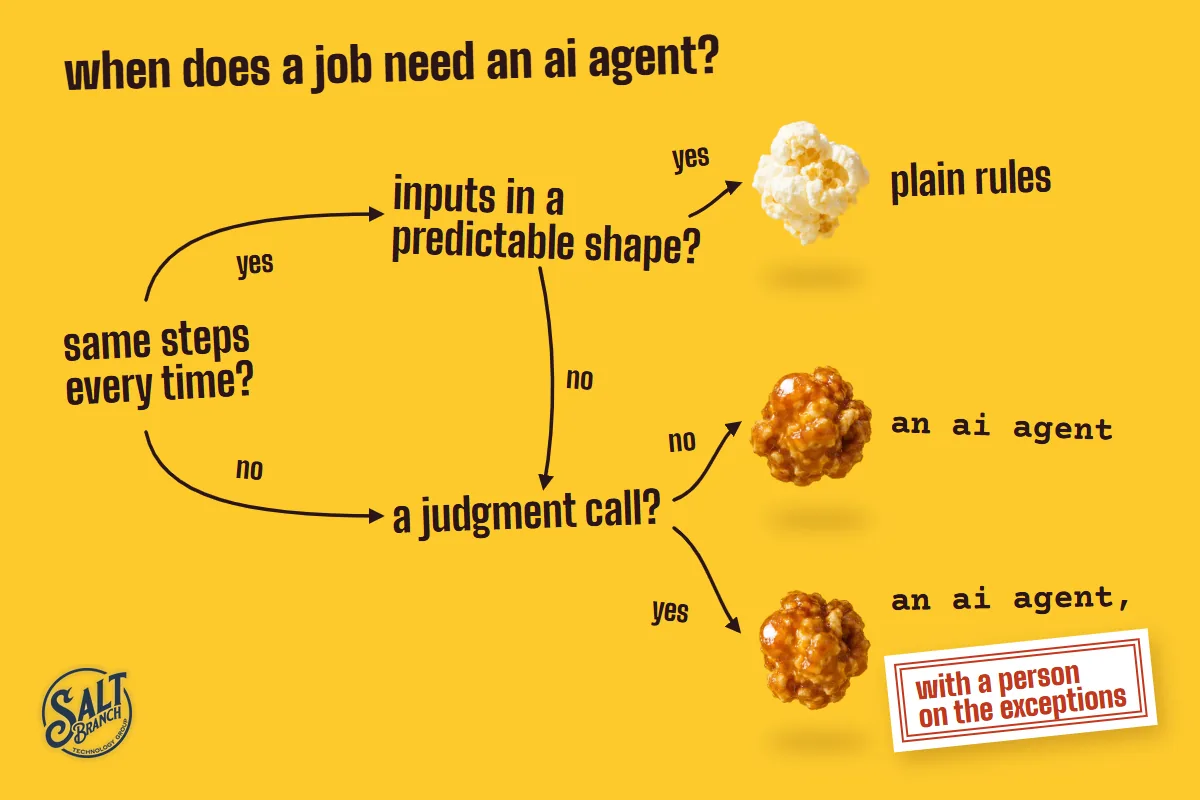
RPA vs AI agents: what changes?
Robotic process automation (RPA) is automation that works a computer’s screens the way a person would, by following recorded steps. It’s useful when an old system has no other way in, and brittle when a screen changes. An AI agent can read a screen or a document it hasn’t seen before, at the cost of predictability.
Choose RPA for stable screens and high volume. Choose an agent where the screens or documents vary. Where you can, choose a proper connection between systems instead of either one. The equipment finance company’s platform is connected to its servicing and originations systems and to Salesforce. When an evaluator values one machine, the system offers to apply that value to every unit of the same make and model. That’s ordinary software doing ordinary work. In many projects, it’s the cheapest, most reliable part.
How reliable are AI agents today?
AI agents can handle many narrow, simpler tasks and still fall short on long ones. The best evidence is a benchmark, not a sales demo. Treat any agent as good at a step, not yet trusted with a whole job unattended.
A team led by researchers at Carnegie Mellon University built TheAgentCompany benchmark, a self-contained simulation of a small software company with its own internal websites and data. They found that “the most competitive agent can complete 30% of tasks autonomously.” Simpler tasks were often solved, but harder, long-running tasks were still out of reach. That’s a result for the models they tested, in a paper last revised in September 2025, not a law. Models improve. The lesson for a buyer holds anyway: give an agent a narrow step with a check behind it.
That check is usually a person. Our guide to where a person belongs in an AI workflow covers how to set the review points.
Which should you choose for your job?
In AI vs automation, choose by the step, not by the job. Most jobs mix routine steps and judgment calls, so most companies end up with some of each. Here are three levels, and you can start with one and grow into the next.
Good: automate the steps that never vary
Start with rules or RPA for the steps that run the same way every time. These are quick wins with low risk, and they free your people from copying and pasting. If nothing in the job varies, stop here.
Better: add an agent at the one step that needs reading
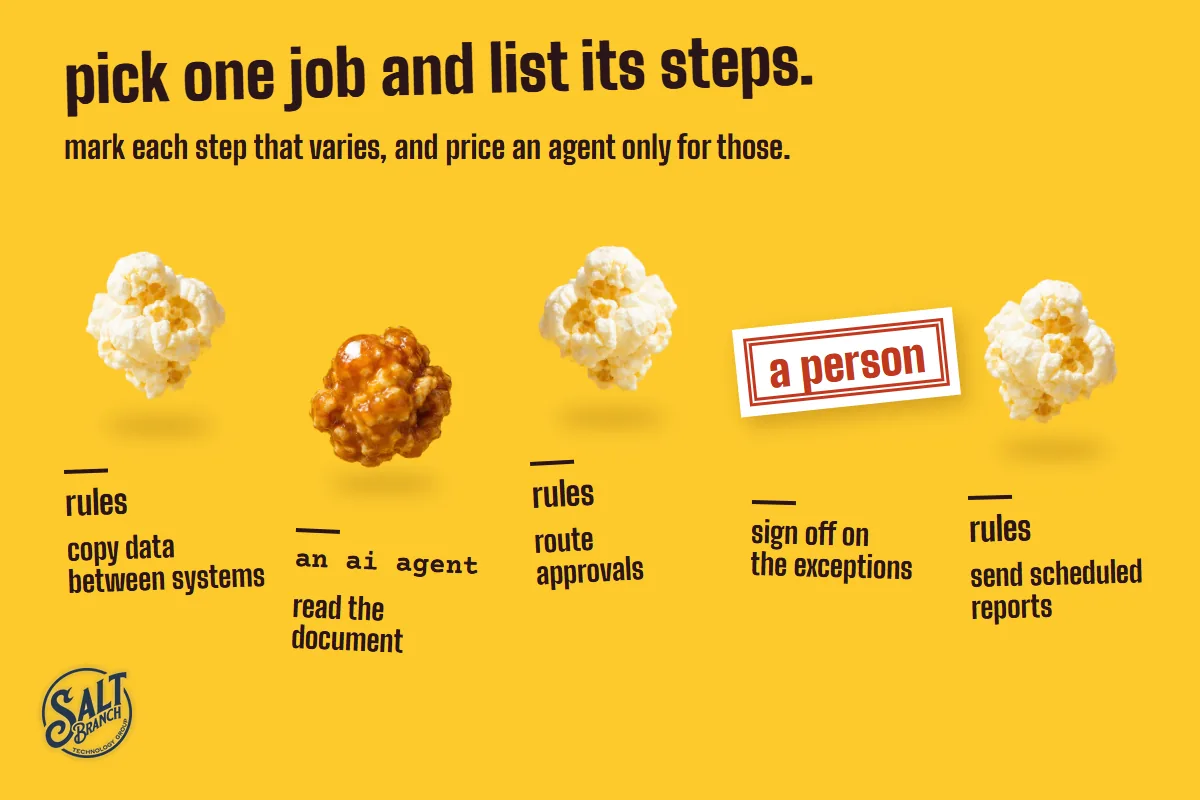
Next, put an AI agent at the step where inputs vary or a call has to be made, with rules on either side of it. The agent reads the document or makes the first-pass judgment. Rules handle everything before and after, and a person reviews what the agent flags.
Best: design the whole job end to end
The best results come from designing the whole job: rules for the routine, agents for the calls, and a person for the exceptions. It works best when you’ve first captured how your experts make their decisions, so the agent decides the way they would.
Here’s what to do next. Pick one job and list its steps. Mark each step that varies, and price an agent only for those. If you’d like help drawing that line, we design automation and AI agents to work together, starting with how the job runs today.