
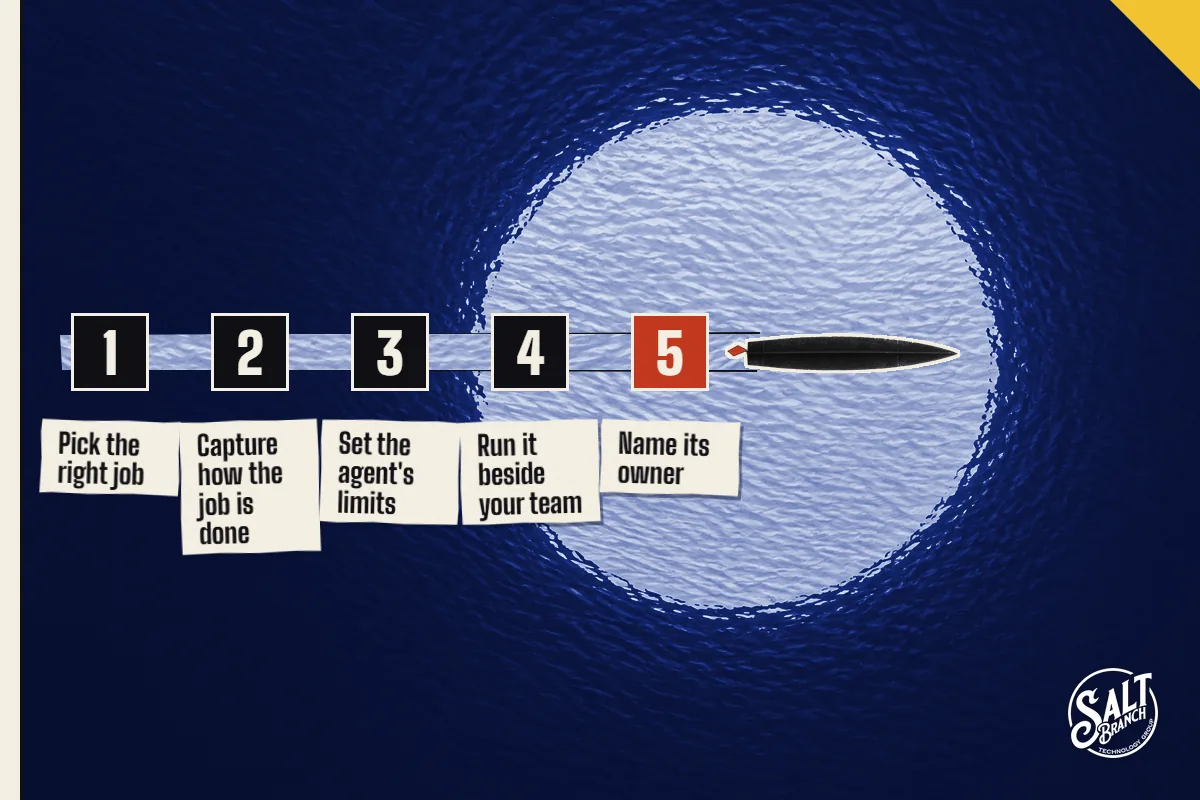
Here’s how to implement AI agents, starting with your first: pick one job that runs often and varies, write down how your best people do it today, give the agent only the access that job needs, run it beside your team until its work holds up, and name one person who owns it. For a company of 50 to 500 people, a first agent done this way is a contained project, not a transformation program. The checklist below is that sequence, item by item.
The most expensive first agent is the one nobody owns. It goes live, nobody checks its work, nobody decides whether to widen it, and a year later nobody remembers why it’s there. That’s why this checklist ends on the owner.
Why use a checklist for your first AI agent?
Most guides on this question are written for the engineers who build agents. They start with models and frameworks. But the decisions that make an agent work in a business are made before and after the build, by the people who run the job.
Implementing AI agents is mostly business work: choosing the job, capturing how it’s done, setting limits, checking the work and giving it an owner. Your first agent also sets the pattern for every one after it.
If you’re still deciding where an agent could help, start with the jobs an AI agent can take on, part 1 of this series.
How to implement AI agents: what do you need first?
You need three things before anyone builds anything: a sponsor, one job and the people who do it. Without them, the project drifts into a tool looking for a problem.
- ☐ A sponsor who can say yes to the time. An owner or general manager, not only IT, because the work changes how a team runs.
- ☐ One job, not a list of ten. A first agent with one clear job can be judged. Ten half-defined jobs can’t.
- ☐ The people who do that job today, available for a few conversations. They know where it goes wrong. Nobody else does.
Phase 1: Pick the right job
The right first job runs often, varies from case to case, and can be measured today. It’s the first step on any AI agent roadmap.
- ☐ It runs often enough to matter: every order, every claim, every deal. The agent’s volume is what pays for the setup.
- ☐ Its inputs or steps vary. If they never vary, plain automation is cheaper and more reliable. Part 4 covers whether a job needs an agent at all, step by step.
- ☐ You’ve measured it today: how long it takes, how often it goes wrong, what a mistake costs. Without a baseline, nobody can say later whether the agent helped.
- ☐ You’ve written down what “done right” looks like, in the words of the person who checks the work today. That definition becomes the agent’s test in Phase 4.
For an equipment finance company we worked with, the job was valuing equipment. It happens on every deal, and every machine is different: its hours, its photos, its make and model. You can see that work among the systems we’ve built for clients.
Phase 2: Capture how the job is done
Before an agent can do a job, someone has to write down how your experts decide, not just what they do. This step decides whether the agent makes the calls your people would.
- ☐ Your experts have walked you through how they decide. Use interviews and their past work, not only a process document. Our guide to capturing how your experts decide covers how to run those conversations.
- ☐ The documents and data the job relies on are where the agent can reach them, through the systems you already have. The agent works with your existing tools, not instead of them.
- ☐ The exceptions are listed: the cases your experts would never let a new hire decide alone. Those go back to a person.
Before the equipment finance company’s agents valued a single machine, we interviewed its veteran evaluators in depth and studied what they had produced over the years.
Phase 3: Set the agent’s limits
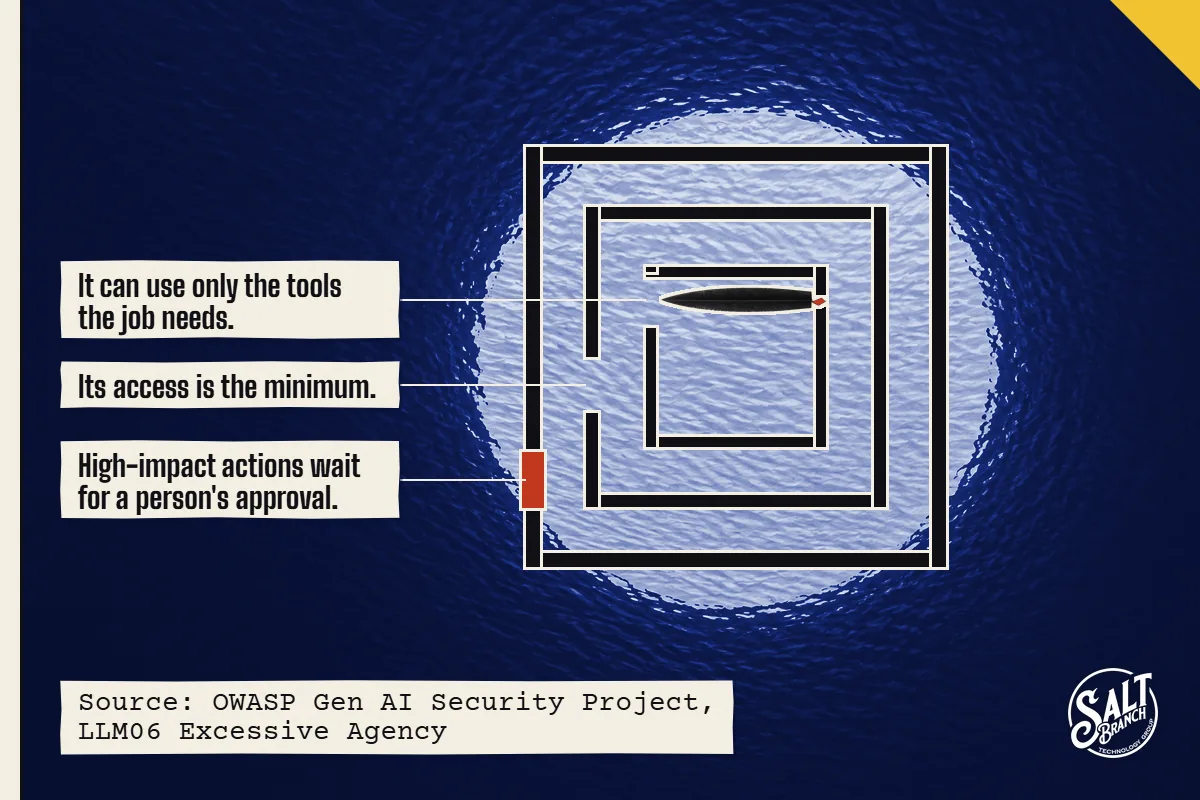
An agent should be able to do its job and nothing more. The OWASP Top 10 for LLM Applications lists “excessive agency” among the top risks of AI applications: an agent that can do more than its job needs can do damage when it gets something wrong. Its limits are a business decision.
An agent runs through the tools and access you give it. The OWASP Gen AI Security Project describes excessive agency as having three root causes: too many functions, too many permissions and too much autonomy.
- ☐ It can use only the tools the job needs. OWASP’s advice is to keep the extensions an agent can call to the minimum necessary.
- ☐ Its access is the minimum. Let it read where it only needs to read. OWASP’s example is a job that only reads data, connected with an identity that can also change and delete it.
- ☐ High-impact actions wait for a person’s approval. OWASP recommends human-in-the-loop control “to require a human to approve high-impact actions before they are taken.” Our guide to a person approving the calls that matter covers where to put that review.
Phase 4: Run it beside your team before you rely on it
Deploying an AI agent is a business decision, not a server setting. The agent goes live on real work only after it has run beside the people who do the job today, and its results have held up against their standard.
- ☐ It runs in parallel with your team, on real work, and they compare. The two results sit side by side.
- ☐ Someone checks a sample of its work every week against the “done right” definition from Phase 1. A sample catches drift early.
- ☐ Every decision it makes leaves a record of what it saw and why. The OECD’s AI principles ask for traceability across an AI system’s data, processes and decisions, so its results can be analyzed later. When a result looks wrong, the record tells you why.
- ☐ You’ve agreed in advance what result earns it more of the job, and what result pulls it back. Set the bar before the trial, not after a good week.
Phase 5: Name its owner
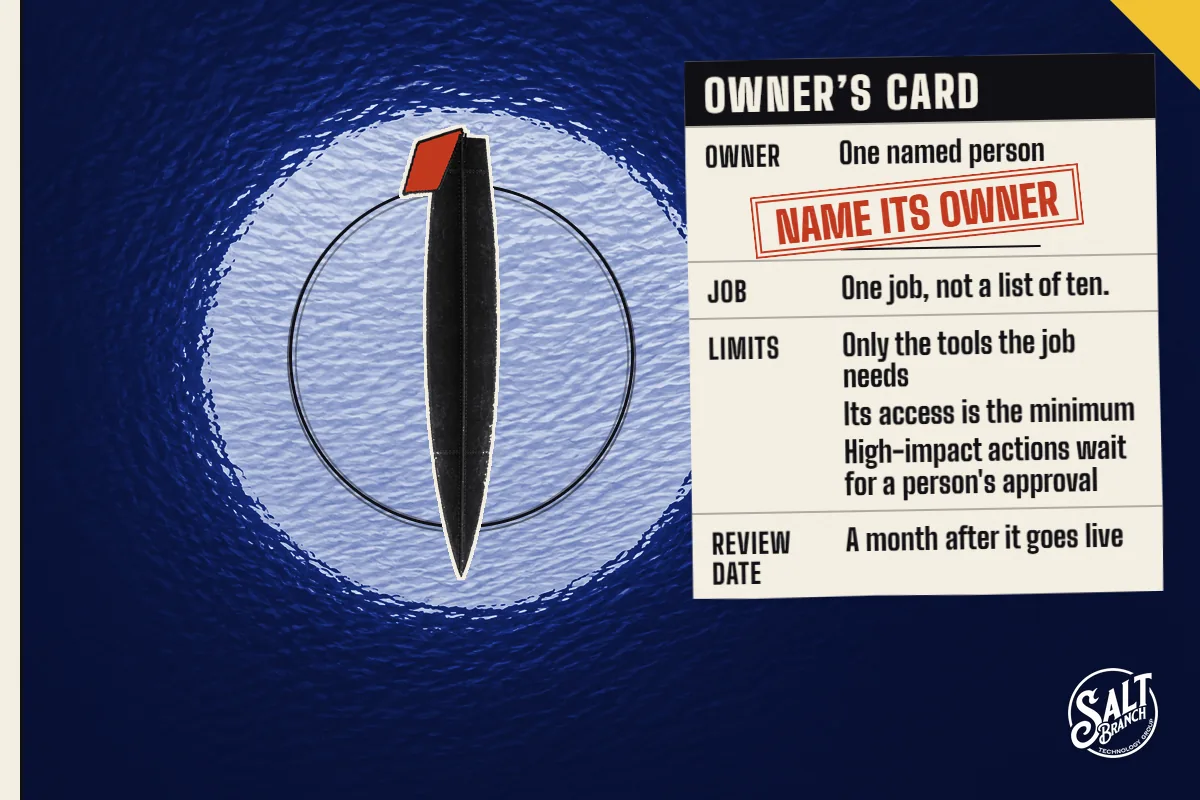
Every agent needs one named person who answers for its results. The same OECD principle puts it plainly: “AI actors should be accountable for the proper functioning of AI systems.”
That’s an intergovernmental standard, not a US law, but it’s the plain standard: someone answers for it. In a company of 50 to 500 people, that means a named person, usually the manager of the team whose job the agent does. Not “IT”, and not “the vendor”.
- ☐ One person owns the agent’s results, by name. A shared owner is no owner: when its work slips, one person has to notice and act.
- ☐ The owner reviews the cases where the agent and the experts disagree, and keeps the expert’s reason. Each reason is know-how you’d otherwise lose, and it can be fed back into how the agent decides.
- ☐ The owner decides when to widen it, pause it or retire it. That decision uses the result you agreed on in Phase 4, so it doesn’t wait for a meeting.
The result has a shape you can recognize. At the equipment finance company, two agents now value every machine by two different methods, and a smaller, more capable team of evaluators takes the difficult cases. The agents carry the volume. The people carry the judgment.
Bonus checks
These three are quick, and each one heads off a problem later.
- ☐ The job still gets done when the agent is down. Someone knows how to do it by hand.
- ☐ The people affected know what the agent does and who to ask about it.
- ☐ A review date is on the calendar for a month after it goes live.
What comes after your first agent?
After your first agent, you widen carefully: good, better, best. Each level builds on what the first agent taught you.
- Good: one agent on one job, with its limits, its checks and its owner.
- Better: a second job, using the same limits, the same weekly checks and the same owner’s card.
- Best: the whole job designed end to end, with rules, agents and people each where they fit.
That’s how to implement AI agents in the order that works: the job, the know-how, the limits, the trial, the owner. If you’d like help picking the first job, we put AI agents and automation to work in your operations, starting with a conversation about how that job runs today.