

Tribal knowledge is the know-how your business runs on that lives in people’s heads instead of in any system: which supplier to call, how a veteran prices a tricky job, why one machine is worth more than its twin. You keep it by capturing how your experts decide, not just what they know, while they’re still here. Interview them, study the work they’ve already produced, and put both where your team and your AI agents can use it.
For a company of 50 to 500 people, this isn’t a distant worry. The Bureau of Labor Statistics (BLS) counts workers 55 and older at 22.9% of the US labor force in 2025. In a company your size, that’s often the people who built the spreadsheets and know the exceptions. Waiting until the retirement party is the expensive way to learn what they knew.
What is tribal knowledge, and why is it a problem now?
Tribal knowledge is what your people know that nobody wrote down: the shortcuts, exceptions and judgment calls that keep the work moving. It becomes a problem the day the person who holds it leaves.
You’ve probably heard some version of it. Only one person knows how to quote that kind of job, and the pricing spreadsheet makes sense only to the person who built it. None of this is anyone’s fault; it’s how a business grows when the people doing the work are too good at it to stop and document it.
Why now: the workforce is getting older. In the BLS civilian labor force tables, workers 55 and older made up 22.9% of the labor force in 2025, and BLS projects 23.4% for 2035.
The same know-how is what an AI agent needs. One of the jobs worth handing to an AI agent is answering questions from your own documents, and an agent can only answer from what someone captured first.
Tribal knowledge vs institutional knowledge: what’s the difference?
Institutional knowledge is everything an organization knows, written down or not. Tribal knowledge is the part that lives only in people and teams. Many companies prefer to say institutional knowledge; both names describe the same risk, which is know-how you can lose.
| Institutional knowledge | Tribal knowledge | |
|---|---|---|
| Where it lives | Manuals, systems, files, and people | Only in people’s heads and a team’s habits |
| How it leaves | A system is retired, files get lost | Someone retires, changes jobs or gets sick |
| How you keep it | Organize it and keep it current | Capture it from the people who hold it, while they’re here |
The useful question isn’t which word to use, but how much of what your business knows sits only in the right-hand column.
What’s the quick fix?
The quick fix takes a week. Ask your two or three most indispensable people for the ten questions they answer most, record their answers, and put them where everyone already looks. It stops the bleeding, but it doesn’t capture judgment.
- Pick the people you would least like to lose next month.
- Collect their questions for a week, then choose the ten most common.
- Record the answers in a conversation, then type them up; a form they never finish captures nothing.
- Put them where people look first: the shared drive, the intranet or the team’s chat.
This gets the easy answers out of their heads. It won’t tell you why your best estimator added a margin on one job and not another.
Why does know-how stay in people’s heads?
Know-how stays in people’s heads because that’s how businesses grow. What worked at the start keeps working until the company is big enough that it doesn’t, and by then the people who know the most are the busiest.
The business grew on what worked. An equipment finance company we worked with kept an Excel workbook for every customer, with a new sheet for each loan. Ten years on there were thousands of them, no two alike. That’s what a growing business does.
The experts are too busy doing the work. Writing it down always loses to the job in front of them.
The hard part is judgment. A form can hold a price list. It can’t hold why one comparable sale counts and another doesn’t, or which customer’s “urgent” really is. That judgment is the most valuable part, and the hardest to capture.
How do you capture tribal knowledge for good?
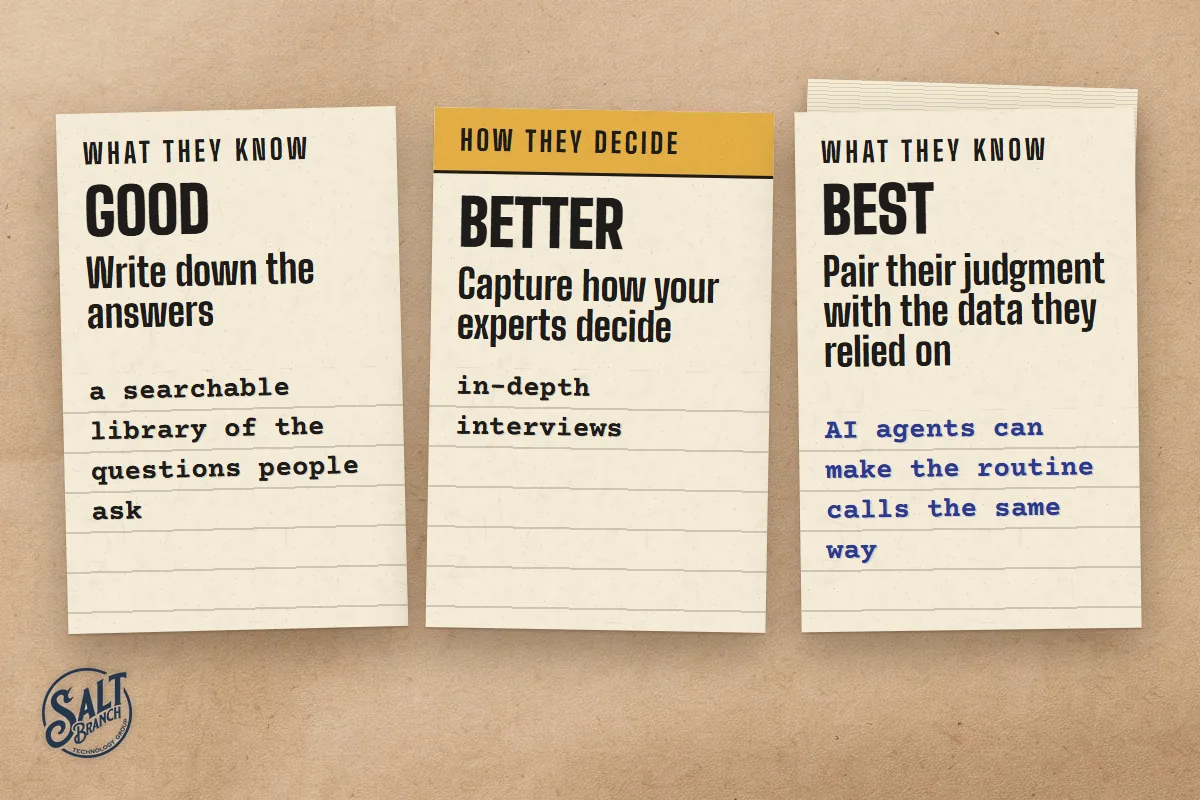
You capture it for good in three steps, each worth more than the last: write down the answers, capture how your experts decide, and pair their judgment with the data they relied on. Good, better and best, and you can start with one and grow into the next.
Good: write down the answers
The good option is a searchable library of the questions people ask, with the answers, and a named owner who keeps it current. It’s the quick fix grown up. An AI agent can answer from it too, through retrieval over your own documents: the agent finds the right passage and answers from it, instead of guessing.
Its weakness: a library holds answers, not reasons, so it stalls on the unusual questions.
Better: capture how your experts decide
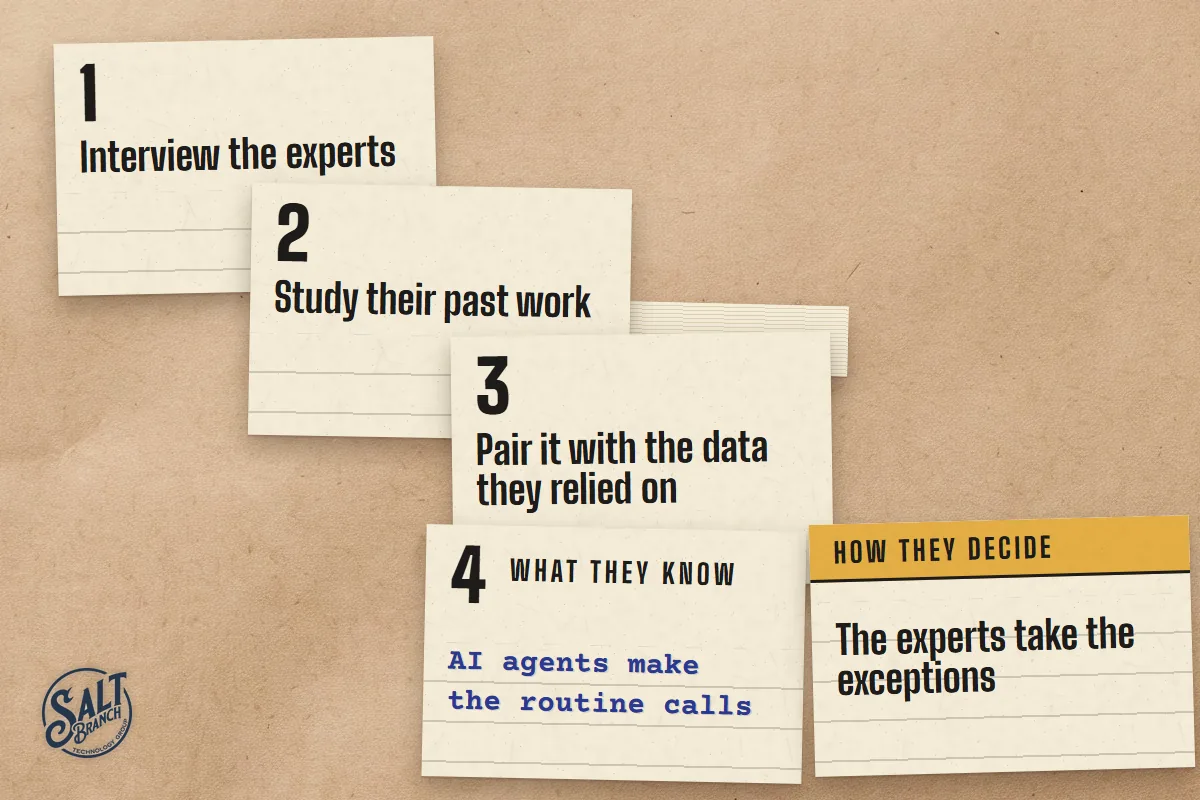
The better option captures the reasoning behind the answers. You do it with in-depth interviews and a study of the work your experts have already produced, because their past decisions show how they think.
That equipment finance company had a pressing reason. Several veteran equipment evaluators, the people who knew what every machine was worth, retired or moved on. Their knowledge was walking out the door. Before they left, we interviewed them in depth and studied years of their valuations: which comparable sales they trusted, how they read hours and condition, why where a machine was built can change its value.
Best: pair their judgment with the data they relied on
The best option puts that captured judgment next to the data the experts used, so AI agents can make the routine calls the same way while your experts take the hard cases. Know-how and data together do what neither does alone.
For the equipment finance company, we also built a database of about 2 million equipment sales and listings. Now two AI agents value every machine by two different methods. When they agree, the value is approved; when they don’t, a smaller team of evaluators decides. That’s keeping a person on the calls an agent can’t settle, and it means the company’s capacity no longer depends on how many evaluators it can hire.
Captured know-how helps your newest people most. In a study published by the National Bureau of Economic Research (NBER), researchers followed 5,179 customer support agents after they got an AI assistant. Issues resolved per hour rose 14% on average, and 34% for novice and low-skilled workers, with minimal impact on the most experienced. The authors report suggestive evidence that the tool spread the best practices of more able workers. Your veterans’ judgment, captured, is what a new hire can borrow on day one.
Know-how also hides in files, not only in heads. A national insurance network’s agents had kept their lead invoices and receipts for years. We collected years of lead invoices from several hundred agents, digitized them and tied each purchase to whether it became a sale. For the first time, the network could see which lead sources drove revenue. The engagement’s result, as recorded: more than $2 million saved a year.
How do you keep it from piling up again?
You keep it from piling up again by making capture part of the job, not a project. Every expert decision leaves a short record of why, the library gets reviewed as part of the work, and when an agent and an expert disagree, you keep the expert’s reason.
- Make every call leave a record. When an expert overrides a price, a value or a rule, they note why in a sentence. Over a year, those sentences become the next layer of captured judgment.
- Review as you go. Whoever owns a section of the library checks it when the work changes, not once a year.
- Learn from disagreements. When an AI agent and an expert disagree, keep the expert’s reason; it’s how the agent gets better at the routine calls.
- Start early. The best time to capture is while your experts have years left, not weeks.
When should you get help?
Get help when the knowledge sits in more files than anyone could read in a year, or when your experts are leaving within months. Both are races against time.
You can do the good option yourself this quarter. The better and best options take planning: who to interview first, and what data their decisions really rest on. If that’s where you’re stuck, talk with our AI consulting team in Fort Worth. We’ll start with who holds the knowledge and how the work runs today, then lay out good, better and best options for keeping it.