

Human in the loop AI means a person sits at a set point in an AI system’s work: approving an action before it happens, checking results after, or deciding the cases the AI can’t settle. For a business putting AI agents to work, it’s how the agent takes the volume while your people keep the judgment calls. The real question isn’t whether to keep a person in the loop, but where they sit and what they check.
For a company of 50 to 500 people, that question arrives with the first agent. A chatbot only answers; an agent acts. It sends the email, updates the record and approves the routine case. So every agent needs limits someone set and an owner who answers for its work. Place the person badly and you get one of two failures: a bottleneck, with someone approving every step, or a rubber stamp, with someone clicking approve on everything.
What does human in the loop mean, in plain English?
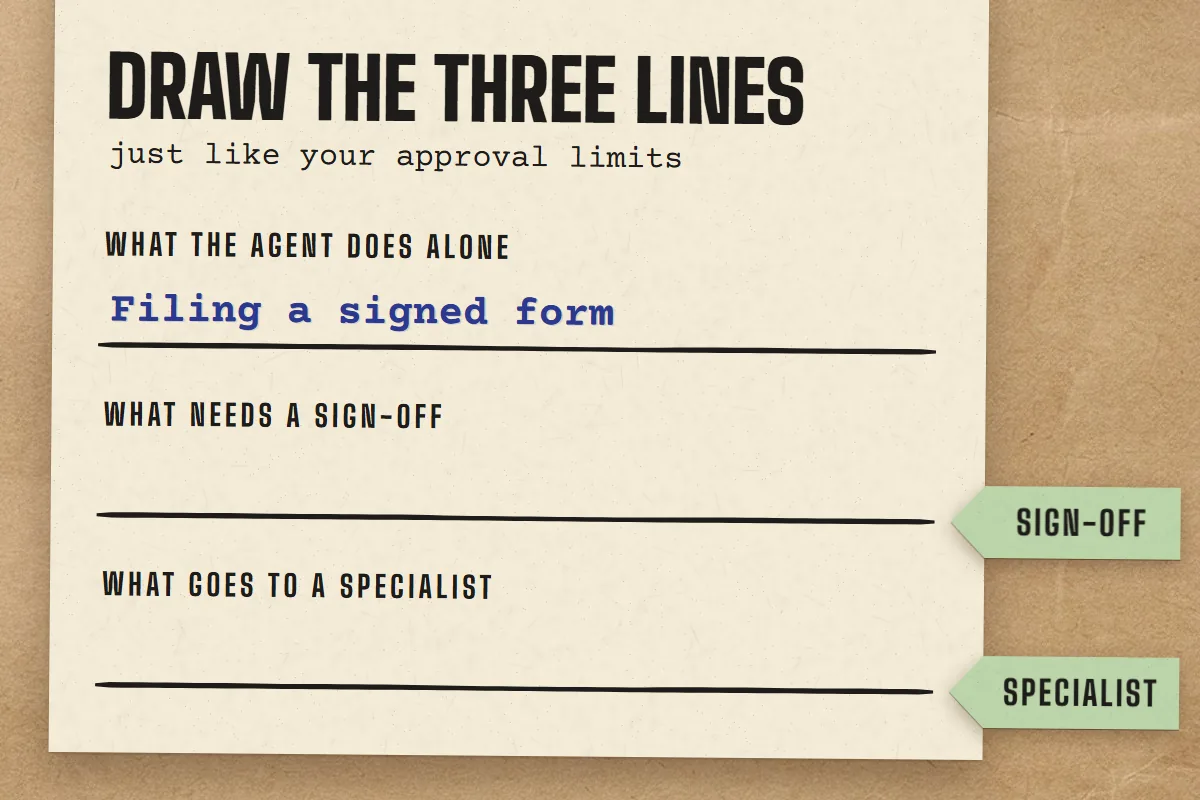
In plain English, human in the loop means the AI does the work up to a line, and a person decides past it. You already run your company this way. Anyone can order supplies up to a set amount, a manager signs above it, and some calls go straight to a specialist. An AI agent needs the same three lines: what it may do alone, what needs a person’s sign-off, and what goes to an expert.
That’s the idea behind the seven jobs worth handing to an AI agent: the agent takes the volume, and a person owns the result.
The National Institute of Standards and Technology (NIST) describes the same range in its AI Risk Management Framework. Human-AI configurations, it says, “can span from fully autonomous to fully manual.” An AI system can make a decision itself, defer it to a human expert, or give a person an additional opinion. Your business will likely use all three, job by job.
Human in the loop vs human on the loop: what’s the difference?
Strictly, a human in the loop approves before the action happens. A human on the loop lets the agent act, then reviews its work and can step in. Out of the loop means fully automatic, which suits only steps that never vary.
| Where the person sits | What it means | Use it for | An everyday example |
|---|---|---|---|
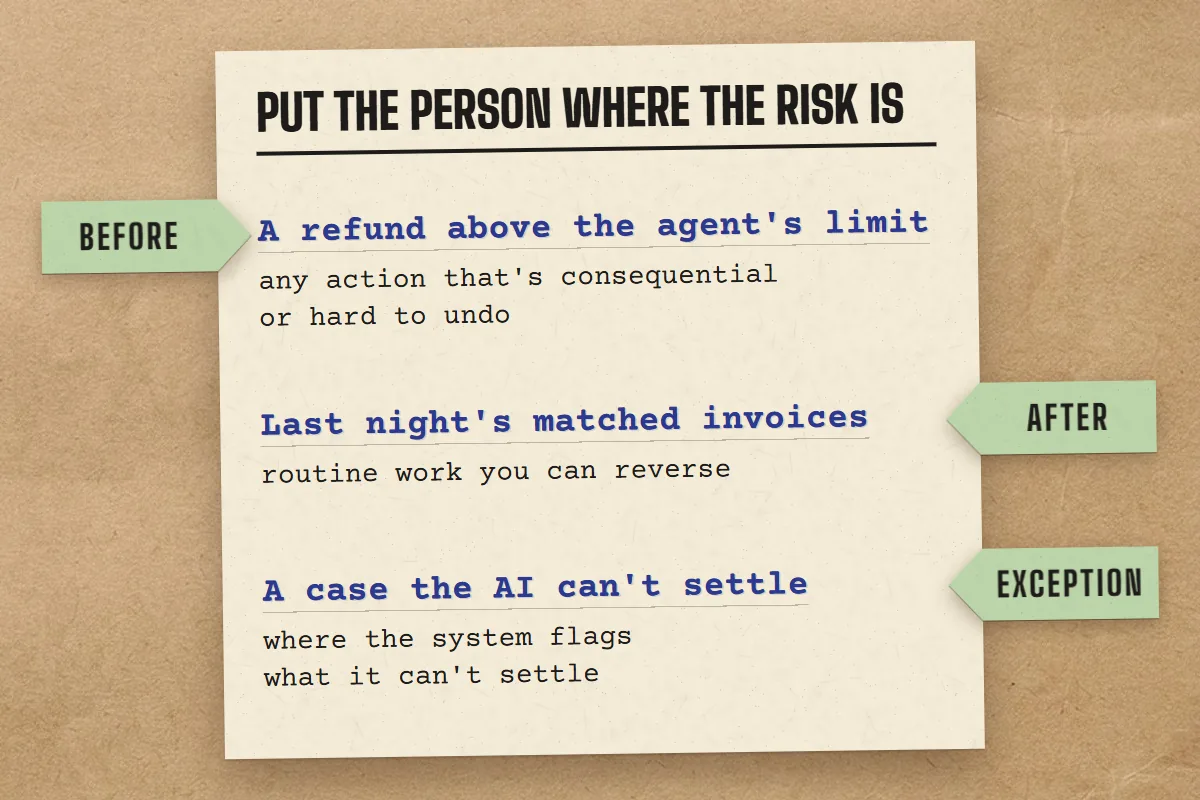
| In the loop | A person approves before the action | Anything costly or hard to undo | A refund above the agent’s limit |
| On the loop | The agent acts; a person reviews and can step in | Routine work you can reverse | Last night’s matched invoices, checked each morning |
| Out of the loop | Fully automatic | Steps that never vary | Filing a signed form in the right folder |
In everyday use, “human in the loop” covers the first two rows, as it does in this guide. The labels matter less than the habit behind them: decide, action by action, how far the agent goes before a person looks.
Where should a person sit in an AI agent’s work?
Put the person where the risk is: before the action, after it, or on the exceptions. Before any action that’s consequential or hard to undo, such as money moving, a promise to a customer, or a legal or safety call. After the fact, by checking samples, for routine work you can reverse. And on the exceptions, where the system flags what it can’t settle.
The exceptions are often the best place. An equipment finance company we worked with now values equipment this way: two AI agents value every machine by two different methods. When they agree, the value is approved; when they don’t, a smaller team of evaluators decides. The evaluators spend their time on the hard cases, not on every machine.
Some systems use more than one placement. On Enslaved Texas, a nonprofit partnership, several AI models read 160-year-old handwritten voter registers. Fields where every source agrees resolve automatically, and conflicts go to a person. Reviewers check the machines’ work one two-page spread at a time, a reviewer’s correction never overwrites the original reading, and any visitor can report an inaccuracy on a record.
Whoever sits in each spot, write it down. NIST’s framework says people’s “roles and responsibilities in decision making and overseeing AI systems need to be clearly defined and differentiated.” Our rule of thumb: one named owner for each agent.
Why can a person in the loop still miss mistakes?
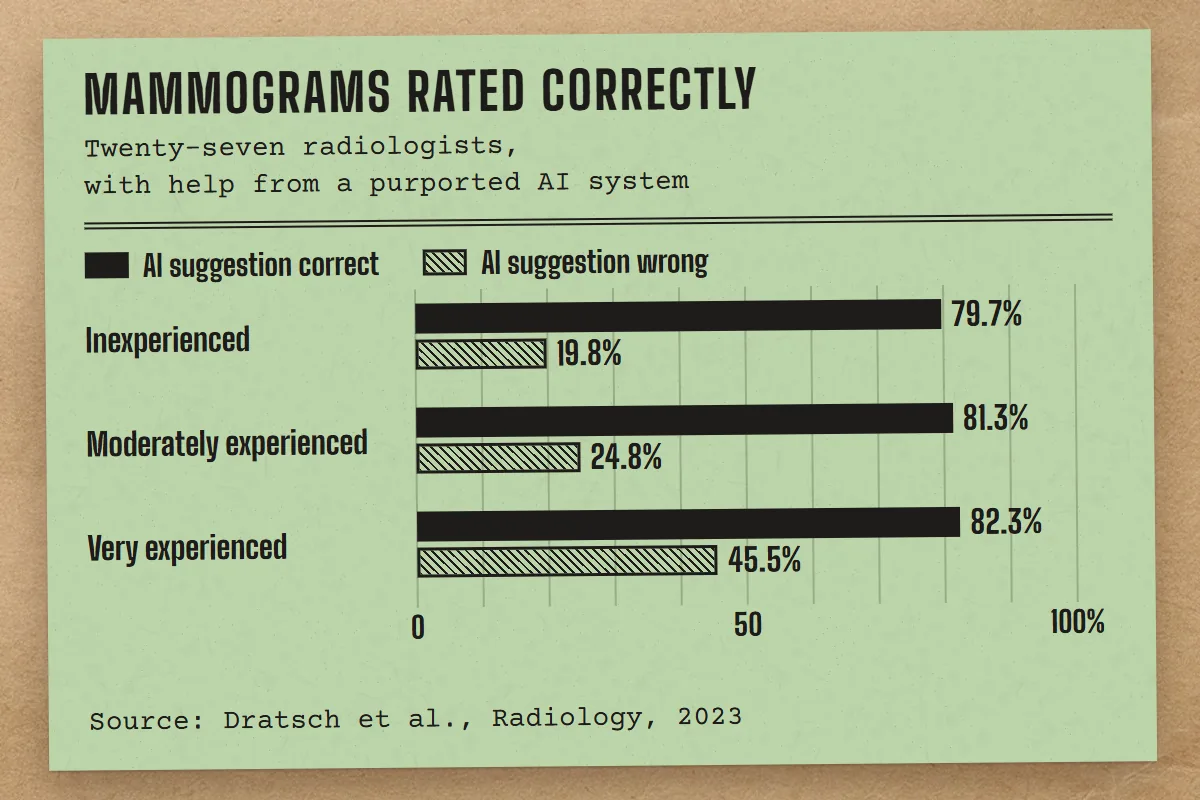
A person in the loop can still miss mistakes, because people tend to trust a machine’s suggestion even when it’s wrong. Researchers call this automation bias. It’s why a loop needs more than a person and an approve button.
A 2023 study in the journal Radiology measured it. Twenty-seven radiologists read 50 mammograms with help from a purported AI system whose suggestions the researchers controlled, and 12 of its suggestions were wrong. Inexperienced readers rated 79.7% of mammograms correctly when the suggestion was right, and 19.8% when it was wrong. For very experienced readers, the figures were 82.3% and 45.5%.
Machines skip warnings too. On decks.app, a game platform we built and run, an audit caught the AI models ignoring soft warnings 71% of the time, so those warnings became hard rules. A warning an AI can skip isn’t a check.
So design the loop to keep the check honest:
- Show the reviewer the evidence, not just the answer.
- Use a second, independent method where you can, as the two valuation agents do.
- Turn every must-not into a hard limit the agent can’t cross.
How do you put a human in the loop?
To put a human in the loop, list what the agent will do, rate each action by what a mistake would cost and whether you can undo it, and draw the lines where a person approves, checks or decides. Put it on one page, written with the people who do the work today. You don’t need new software to draw the lines; you need a clear view of what the agent will do.
- List every action the agent will take. Reading, drafting, updating a record, sending, approving.
- Mark each one by consequence and reversibility. Ask what happens if it’s wrong, and whether you can undo it.
- Draw the three lines. What the agent does alone, what needs a sign-off, and what goes to a specialist, just like your approval limits.
- Name one owner. The person who checks the agent’s work, answers for it, and decides when it’s ready for more.
- Track overrides and agreement. Count how often people correct the agent, and how often two methods agree.
- Move the lines with the record. Widen the agent’s limits when the numbers earn it, and tighten them after a miss.
What mistakes should you avoid?
The five to avoid: a person on every step, a reviewer who sees only the answer, warnings where you need limits, no named owner, and limits nobody revisits. Each one quietly turns a loop into a bottleneck or a rubber stamp.
- A person on every step. If someone approves everything, the agent saves little, and the approval queue becomes the new bottleneck.
- A reviewer who sees only the answer. Without the evidence behind it, review turns into a rubber stamp.
- Warnings where you need limits. If the agent can skip a rule, plan as if it will.
- No named owner. When everyone can approve, nobody answers for the result.
- Limits set once and forgotten. The right line in week one is rarely the right line in month six.
Questions about human in the loop AI
How can humans stay in the loop on AI?
People stay in the loop when the system is built to stop for them. Give each agent written limits, route anything past them to a named person, and show that person the evidence behind the agent’s answer. Then track how often they change it.
Does human in the loop slow everything down?
Not when the person sits in the right place. Routine work you can reverse runs on its own and gets checked by sample, while people see the consequential calls and the cases the system can’t settle. Their time goes where judgment is needed.
Who should be the human in the loop?
Usually the person who makes the call today. Their knowledge is what the agent’s limits should capture, and their judgment is what the hard cases need. Give one person ownership of each agent, even when several people review its work.
What is an example of human in the loop AI?
In one system, two AI agents value each machine for an equipment lender by two methods, and evaluators decide when the two disagree. In another, AI models read old handwritten records, matching readings resolve automatically, and a person settles the conflicts.
What to do next
Pick one job you’d like an agent to take, and write its page: every action, the three lines and one owner. If the hard part is deciding where the lines go, our Fort Worth AI consulting team can work through it with you, starting from how the job runs today.