

AI agent pricing is moving from the seat to the meter. From December 1, 2026, Microsoft turns usage-based billing on by default for new Microsoft 365 Copilot Business licenses sold through its partners, with a preset limit of 4,000 Copilot Credits per user each month. Salesforce already sells Agentforce by the action, at 20 Flex Credits apiece from a $500 pool of 100,000. Three models now sit side by side: a price per seat for the everyday assistant, a price per credit or action for work you hand an agent, and a price per outcome for a job the agent finishes on its own.
For a company of 50 to 500 people, the bill for agents stops being a fixed line and becomes a variable one, with a default limit that an admin sets or forgets. Your job is to decide which model fits each job before the meter decides for you.
What did Microsoft change?
Microsoft made two changes to how Copilot Business is bought, both effective December 1, 2026, and both posted on its Partner Center page in October. First, usage-based billing is on by default for new Microsoft 365 Copilot Business licenses bought through Cloud Solution Provider, the channel through which partners resell Microsoft software, known as CSP. The announcement is dated October 1 and was updated October 14. The scope is new licenses bought through partners, not every Copilot customer.
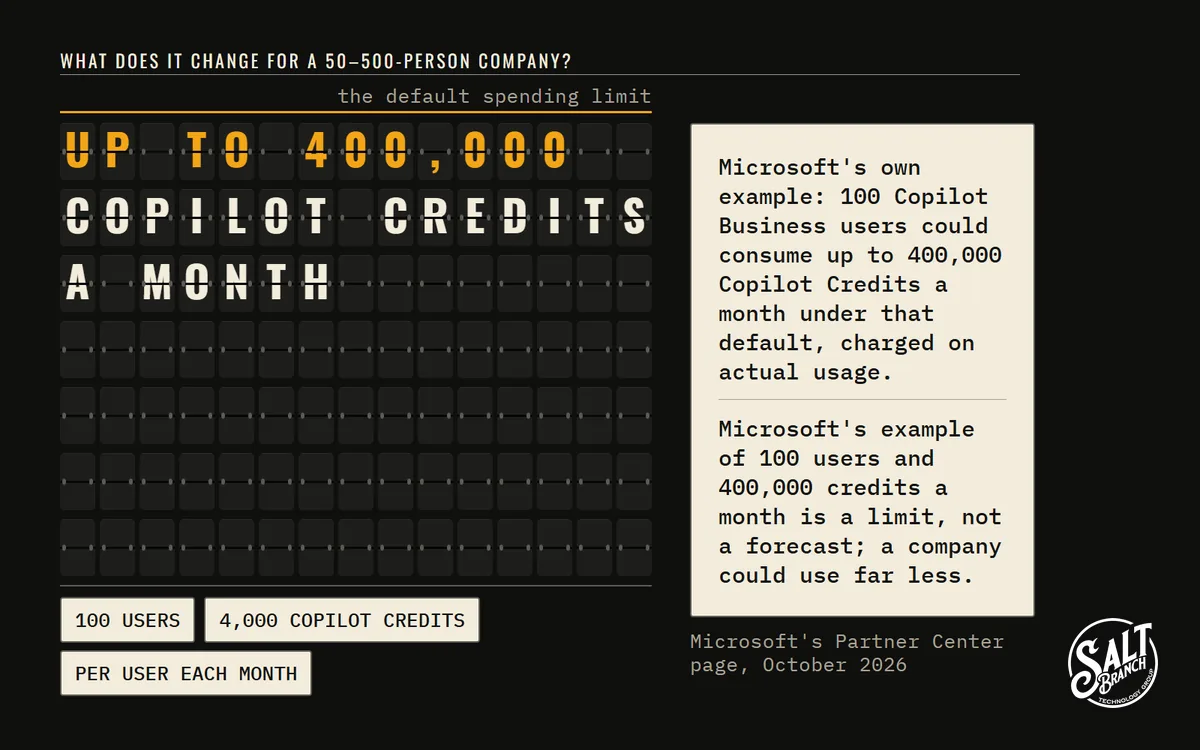
The default spending limit is 4,000 Copilot Credits per user per month, and admins can change it. Microsoft’s own example: 100 Copilot Business users could consume up to 400,000 Copilot Credits a month under that default, charged on actual usage.
Second, from the same date, new Copilot and Copilot Business offers can be bought without a qualifying Microsoft 365 base subscription, at the same price. Microsoft says the change affects how customers buy Copilot, “not the underlying Copilot capabilities.” Microsoft’s Copilot Business pricing page puts the budgeting rule plainly: “Everyday AI is included in your license. Advanced AI—work you hand off—is billed as you use it.”
What are the three AI agent pricing models?
AI agents are priced three ways: per seat for an assistant a person uses all day, per credit or action for work you hand off, and per outcome for a job finished, as the vendor defines finished.
| Model | Who it suits | What you pay for | What to watch |
|---|---|---|---|
| Per seat | The everyday assistant everyone uses | A fixed price per person per month | Seats nobody uses; metered work outside the seat |
| Per credit or action | Work you hand off, with steady volume and written rules | Each action the agent takes, from a credit pool | Who sets the limit; how many actions a job really takes; credits that expire |
| Per outcome | A job the agent finishes, such as a resolved conversation | Each conversation, resolution or result | The vendor’s definition of “done”; what happens when a person steps in |
Per seat: the assistant
Microsoft lists Microsoft 365 Copilot Business at $18 per user a month paid yearly, down from $21 under a first-year promotion for existing Microsoft 365 Business customers that runs through December 31, 2026, or $25.20 per user a month paid monthly (Microsoft’s pricing page, October 2026). The seat covers what Microsoft calls everyday AI, not the agent work it meters in Copilot Credits: today, on its pricing page, Copilot Cowork, Code, Autopilot and the Work IQ APIs.
Per credit or action: work you hand off
Microsoft’s Copilot Credits are, in its documentation, “a common currency for eligible Microsoft services with usage-based billing,” paid through fixed licensing, a pre-purchase plan, pay-as-you-go or prepaid packs. Salesforce does the same with Flex Credits: its Agentforce pricing page lists them at $500 per 100,000 credits, with an Agentforce action costing 20 Flex Credits and a voice action 30. That works out to $0.10 per standard action and $0.15 per voice action, arithmetic from Salesforce’s figures rather than listed prices.
A $5 per user per month Agentforce User License requires Flex Credits. Salesforce says there is no overage penalty, with usage above your entitlement billed monthly in arrears at your contracted rate, and that unused Flex Credits do not roll over. The page calls its prices subject to change, so check it before you budget.
Per outcome: a job finished
Salesforce lists conversations at $2 each, “optimized for external facing customer agents” (its pricing page, October 2026). Customer service is where per-outcome pricing is aimed, and what it costs to resolve a customer conversation with AI covers the per-resolution prices there. The question to ask any outcome price is who decides the outcome happened.
What does it change for a 50–500-person company?
It changes the bill from a fixed line into a variable one, and it hands the budget decision to whoever set up the license. Microsoft’s example of 100 users and 400,000 credits a month is a limit, not a forecast; a company could use far less. But the ceiling exists whether or not anyone chose it.
Two things decide what that means in practice. Microsoft’s documentation says “The Auto-apply new services setting is enabled by default for spending policies,” so a new metered agent inherits your policy unless an admin turns that off. And a per-action price rewards steady, well-defined work and punishes an agent that flails: five actions to do what should take one costs five times as much.
Metered pricing is honest only when you can see what each unit is worth. For a national insurance network with several hundred independent agents who were unknowingly bidding against each other for the same internet leads, we collected years of lead invoices and receipts, tied each purchase to whether it became a sale, and graded leads with AI so bids followed quality. Then we built an internal marketplace where agents buy leads without bidding against each other; the network saves more than $2 million a year. Paying per lead worked because every lead’s value was tracked. Per-action pricing earns its keep the same way.
What doesn’t it change?
It doesn’t change what an agent needs to pay for itself: a defined job, data that’s ready, and a person on the exceptions. A cheaper unit price doesn’t rescue a badly scoped agent; it makes the mistakes cheaper to repeat. A meter tells you what the work cost, not whether it was worth doing.
It also doesn’t change the ownership problem. A metered agent that someone starts on their own account is shadow AI with a running tab: the same question of who owns it, with a bill attached. The fix is the same too: an owner for every agent, and a limit someone chose.
What should you do now?
Decide, before the next license is bought, whether metered AI is a budget line and who owns it. Each role has one job.
Owners and general managers
Decide whether metered agent work is a budget line, and name its owner. A default limit nobody chose is a decision nobody made.
Finance
Before any Copilot Business license is added through a partner, ask what the default spending limit is and set it to a number you can defend. Ask the same of any Agentforce contract: how many credits, the cost above the entitlement, and when they expire.
Operations
List the jobs with steady volume and written rules: order status, intake, document checks. Those are where per-action pricing pays.
Whoever administers Microsoft 365
Open Copilot, then Cost management, in the admin center. Set organization-level and user-level limits, and review the Auto-apply new services setting so a new metered agent doesn’t inherit a policy nobody reviewed.
Count the job before you pick the price
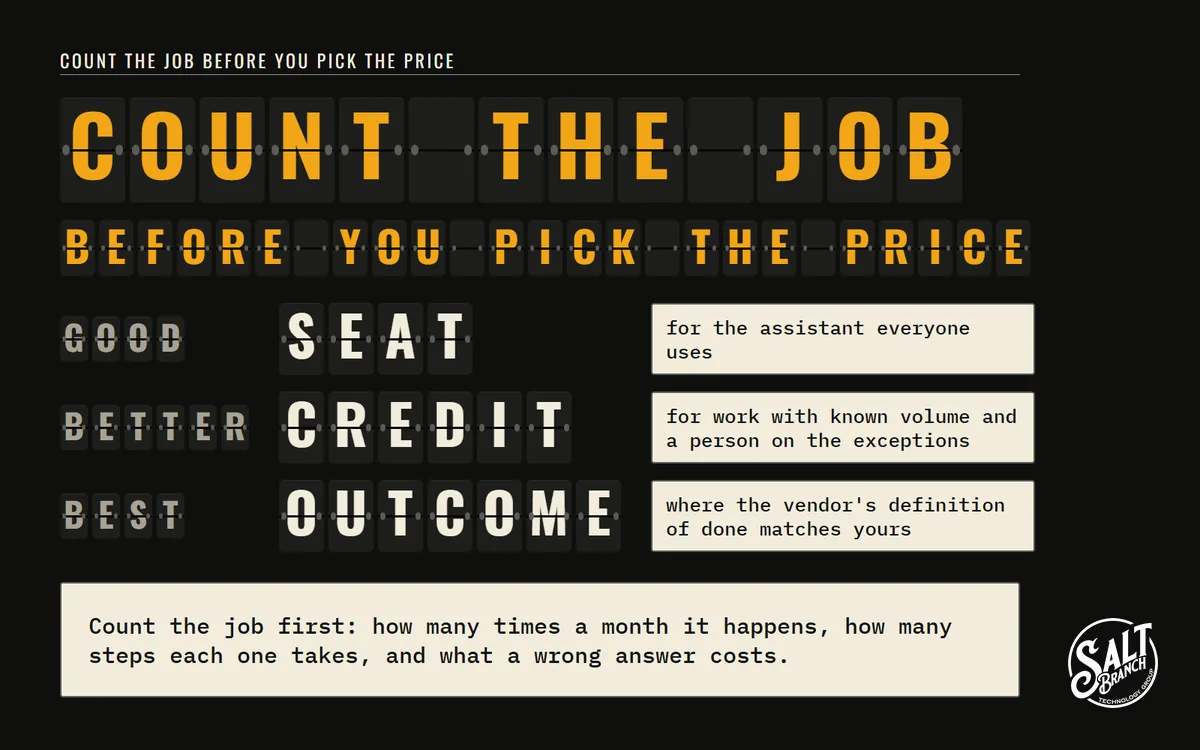
Count the job first: how many times a month it happens, how many steps each one takes, and what a wrong answer costs. The right AI agent pricing model follows from that count, not from the vendor.
A hypothetical shows why. Say a distributor with 120 people wants an agent to answer order-status questions. If the agent handles 3,000 a month at one action each, that is 60,000 Flex Credits, or $300 worth of credits at Salesforce’s listed rate (they’re sold in $500 blocks of 100,000). If each question really takes four actions, it is $1,200. Nothing about the agent changed; the count did.
Good, better, best, in that order: a seat for the assistant everyone uses; credits for work with known volume and a person on the exceptions; an outcome price where the vendor’s definition of done matches yours. If you’re weighing seat, credit and outcome for your own jobs, that is the kind of decision we work through with Fort Worth companies before anything is bought.