PortfolioEquipment finance case study

AI equipment valuation: from spreadsheets to a lender built to scale

An equipment finance company had built its business on knowing what heavy equipment is really worth. After more than ten years, that know-how lived in thousands of customer spreadsheets and in the heads of a few veteran evaluators, some ready to retire, just as larger lenders wanted to see the whole portfolio. We had AI agents turn the spreadsheets into one database, built an asset platform and a field app on top of it, and put AI to work valuing every machine twice. Now the company can grow without its systems holding it back.

Here’s how we built it, and why the same approach matters for your business.
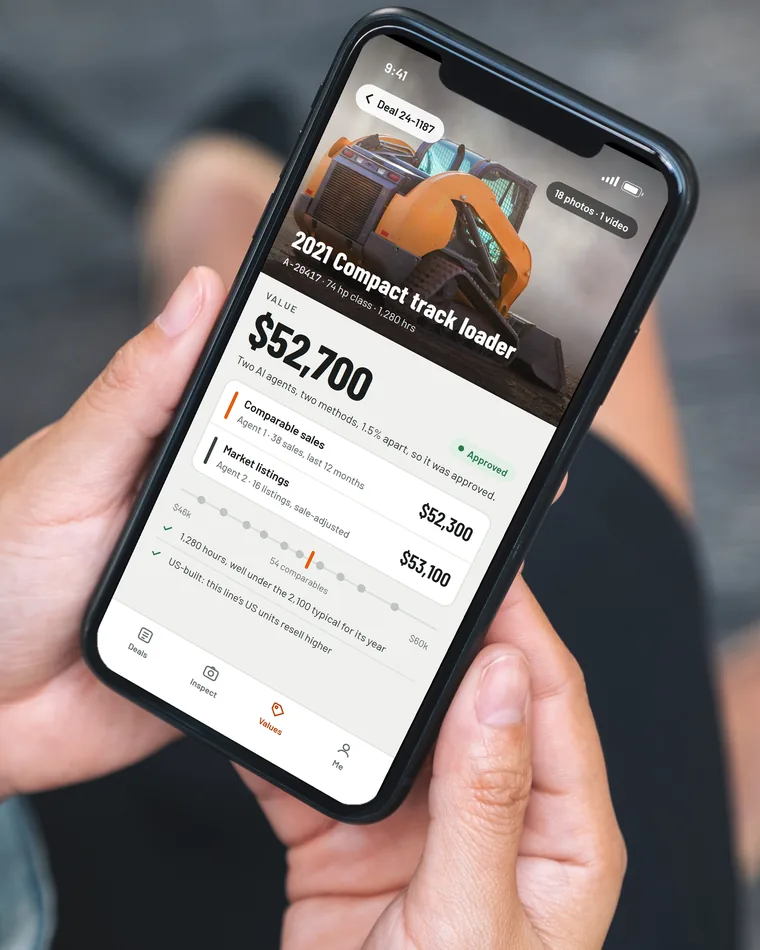
The field app in two hands: a 2021 compact track loader valued at $52,700 by two AI agents, one from comparable sales and one from market listings, 1.5 percent apart, so it was approved

2Msales and listings behind every value

The valuation queue: every machine valued twice, as soon as its deal is loaded

The challenge

A decade of know-how, filed in thousands of spreadsheets

In equipment finance, knowing what a machine is worth is everything: it tells a lender how much it can safely lend, the way a mortgage lender needs to know what a house would sell for. This company knew heavy equipment better than most, from what each machine does and how hard it gets used to how the seasons move its price, and it could lend more flexibly because of it.

Like most growing businesses, it ran on what worked at the start: an Excel workbook for every customer, in a shared folder, with a new sheet for each loan. Ten years on there were thousands of them, no two alike: named differently, color-coded by whoever kept them, with columns added and dropped over the years and values, comments and colors sharing cells. Portfolio questions the team once answered almost in their heads became hard to answer at all.

Then two things happened at once. To keep growing, the company needed capital from larger lenders, who expect real-time reporting on the whole portfolio. And several veteran equipment evaluators, the people who knew what every machine was worth and had built many of those spreadsheets, retired or moved on. Their knowledge was walking out the door. The company needed to:

  • Turn thousands of one-of-a-kind spreadsheets into one set of trusted data.
  • Keep its veteran evaluators’ judgment as they moved on.
  • Value every machine fast and consistently, however many evaluators it had.
  • Give field inspectors a tool that works even with no signal.
  • Connect valuations to originations, servicing and sales.
  • See the whole portfolio in real time, the way larger lenders expect.

Before

How a machine got valued

  1. Photos and videos emailed in from the field, when the signal allowed
  2. A veteran evaluator looks up comparable sales
  3. The value is typed into that customer’s workbook
  4. Sales, servicing and leadership can’t see it without asking

Only as fast as a handful of experts, and only while they stay.

After

How a machine gets valued now

  1. The field app uploads the inspection, even from a site with no signal
  2. Two AI agents value it by two different methods, drawing on about 2 million sales and listings
  3. If they agree, the value is approved; if not, an evaluator decides
  4. The value lands in the machine’s record, where sales, servicing and leadership can see it

Every machine valued as soon as its deal is loaded, and the experts take the hard cases.

How a machine got valued before, and how it’s valued now.

The approach

Four decisions that made it work

Every business has valuable data trapped somewhere: in filing cabinets, in scanned PDFs, in spreadsheets only their authors understand. This company’s was in two places: thousands of customer workbooks, and the memories of the people who filled them in.

Their most valuable asset wasn’t a machine. It was what their people knew.

AI can unlock knowledge like that, but only when the software around it is built for the people who use it: evaluators with decades of experience, inspectors on a job site with one bar of signal, sales reps putting a proposal together. An asset platform nobody wants to open saves nobody anything. That’s product management, and it sits at the center of how we build. Each decision below maps to a problem your business probably has too.

01 · DATA

AI agents read a decade of spreadsheets, the way an analyst would

No two workbooks were alike, so there was no simple import. Over several months, AI agents read every workbook the way a careful analyst would: first learning how the spreadsheets had changed over the years, like a column for titles added one year and one for insurance later, then pulling out every machine, field by field, into one database.

Data like this is messy. Many equipment companies keep the serial number and the VIN in one field, and one cell might hold a value, a comment and a color code. So every record passed through layers of checks that caught collisions like that combined field and confirmed what each workbook really held. By hand, it would have taken hundreds of thousands of hours.

Why it matters for your business

Your business probably runs on spreadsheets like these: years of them, each a little different, understood mainly by the people who made them. AI can now read them the way an analyst would, with checks built in and your people deciding only what’s truly unclear. The result is a database you can report on, and the foundation for any AI you build next.
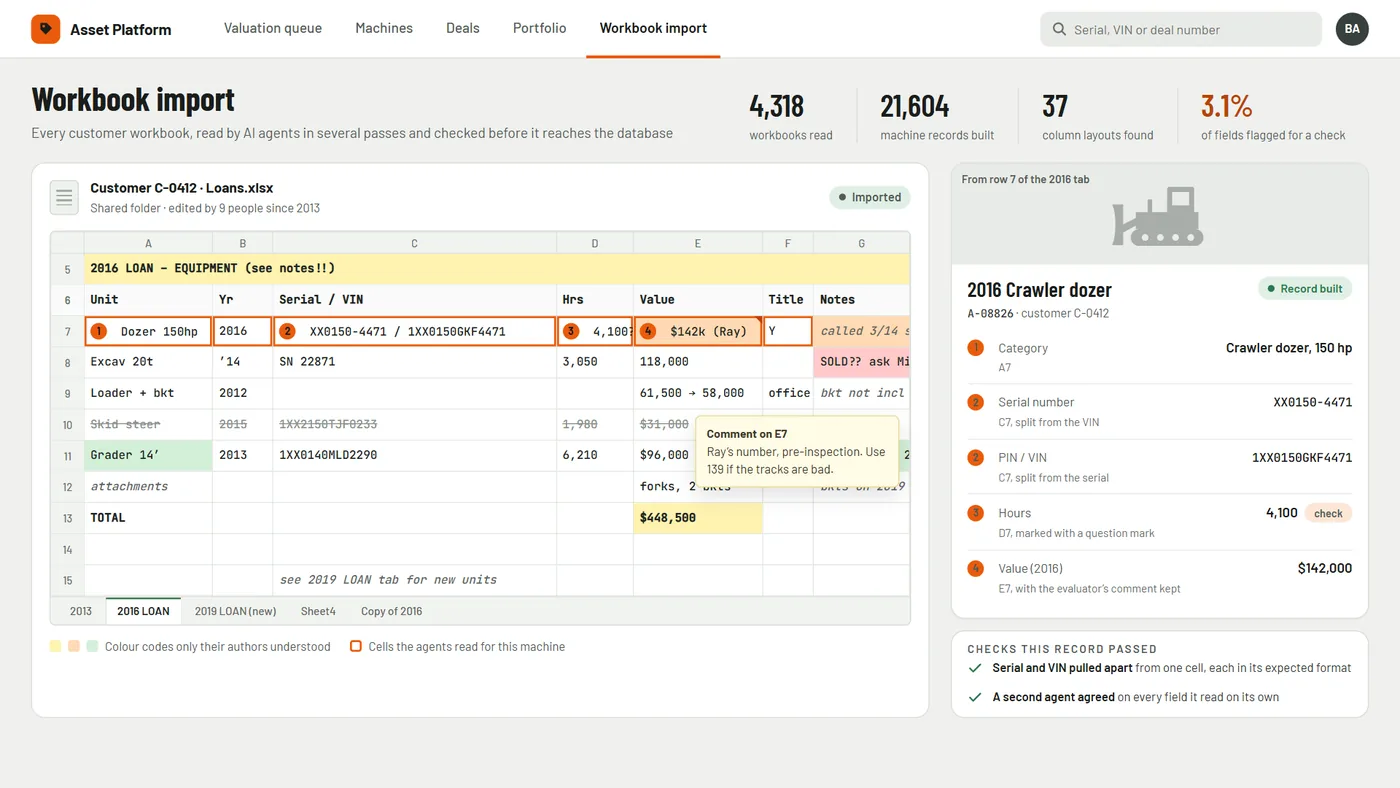
The workbook import: one customer’s spreadsheet, with colour codes, a comment, a struck-through row and a serial number and VIN sharing one cell, beside the machine record AI agents built from one row of it and the checks it passed
One customer’s workbook, and the record AI agents built from one row of it, with the checks each field passed.
02 · ARTIFICIAL INTELLIGENCE

AI values every machine twice, before anyone asks

Before the veteran evaluators moved on, we interviewed them in depth and studied years of their valuations: which comparable sales they trusted, how they read hours and condition, why where a machine was built can change its value. We also built a database of about 2 million equipment sales and listings from across the internet, from auctions to private sales.

Now, as soon as a deal is loaded, AI agents take each machine’s serial number, hours, photos, make and model and find the comparables, the way those evaluators did. Two agents value every machine by two different methods, each with a full write-up. When they agree, the value is approved; when they don’t, a smaller team of evaluators decides. The accuracy blew the client away.

Why it matters for your business

When your most experienced people retire, their judgment doesn’t have to leave with them. We capture how they decide, pair it with the data they relied on, and let AI make the routine calls the same way every time, so your experts spend their time on the hard ones and your capacity stops depending on how many you can hire.

How a machine gets valued: loaded with its deal, valued twice by two AI agents, checked for agreement, then approved or sent to an evaluator. On-screen text, no sound needed.
03 · PRODUCT DESIGN

A field app the inspectors love to use

Valuations start in the field, on job sites and equipment yards where the signal is often poor. Inspectors used to email their photos and videos back to the office. We built them a mobile app around that reality: it keeps every photo, video and note on the phone and uploads them on its own once there’s signal, so nothing is lost.

Small touches made it faster, too. Value one machine, and the app offers to apply that value to the other units of the same make and model. Inspections reach the asset platform in real time, beside everything the office knows about the machine. The field team loved it.

Why it matters for your business

If your people work outside an office, the software has to work where they do: with one bar of signal, in a hurry, without losing a thing. Get that right and they’ll use it every day; get it wrong and they’re back to email. We design around the person holding the phone.
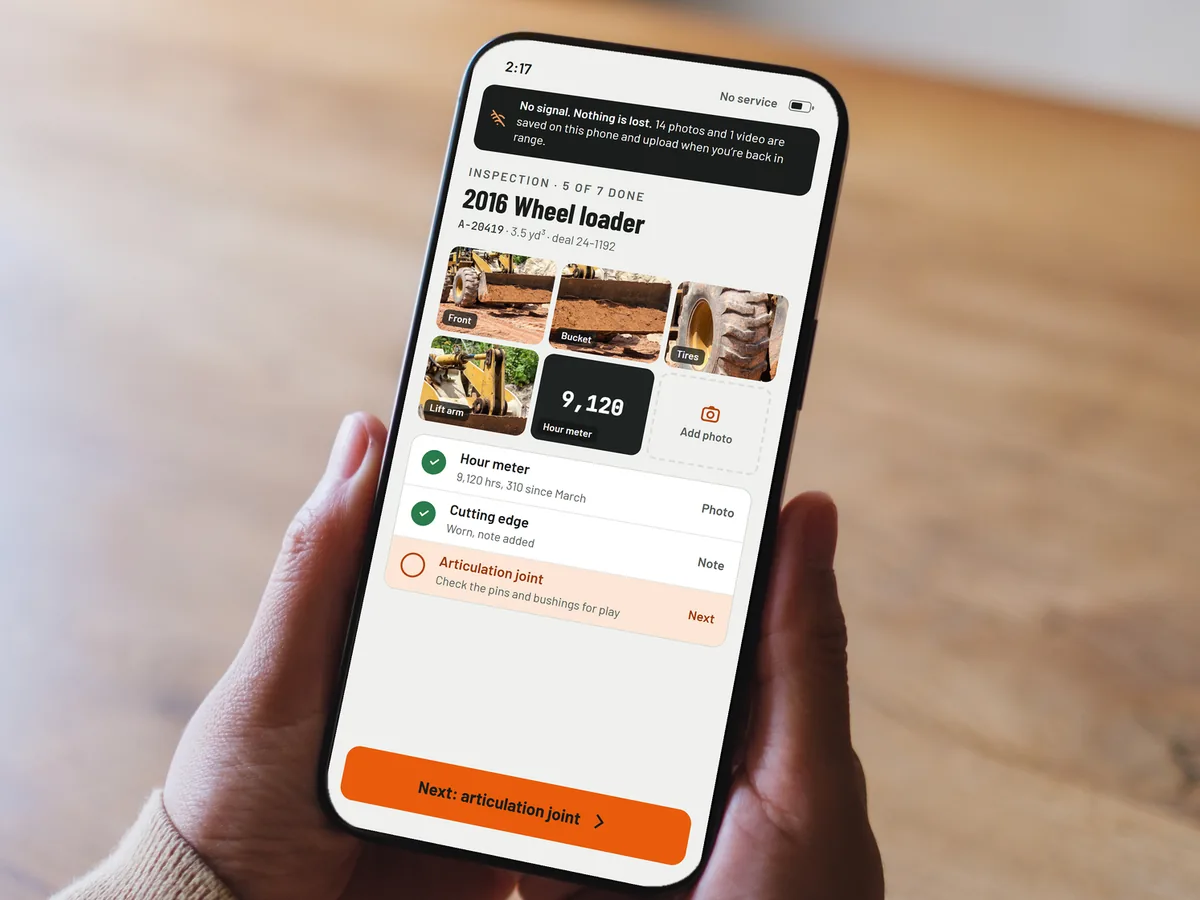
The field app in hand on a site with no signal: a wheel loader’s inspection, with its photos, hour meter and checklist saved on the phone
The field app: an inspection saved on the phone with no signal. It uploads on its own once there’s signal again.
04 · CONNECTED SYSTEMS

Every system connected, and the whole portfolio in view

Like most established companies, this one already ran on other systems: one for originating deals, one for servicing loans, and Salesforce for sales. We connected the asset platform to all of them, so a sales rep building a proposal sees the same machine, and the same value, as the evaluators.

We also gave every machine one record for life. A machine used to exist only as long as its contract, but equipment comes back: a contract ends early, the machine sells at auction, and years later it returns with a new customer. Now its whole history stays with it. And leadership finally sees the whole portfolio as it stands today: by segment, by location, hot spots and all.

Why it matters for your business

Most companies already own the systems they need; those systems just don’t talk to each other. Connect them, let every record keep its history, and you see your business as it is today, not as of the last report someone had time to build. It’s also exactly what banks and investors ask to see.
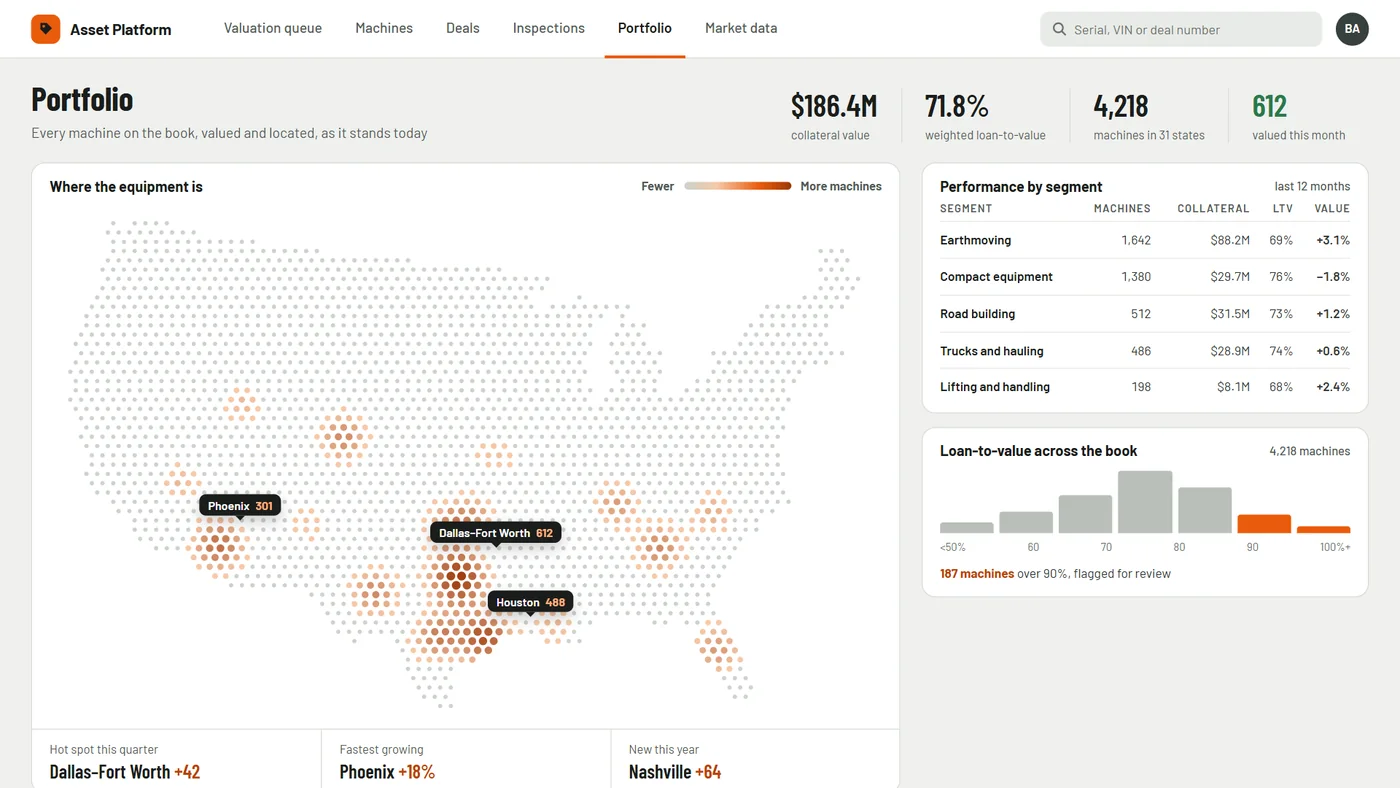
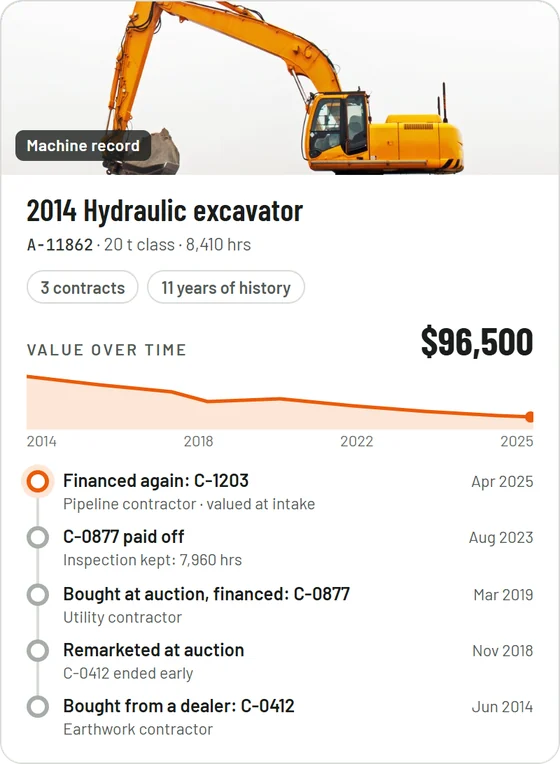
The portfolio: collateral value, loan-to-value and machines financed, a map of where the equipment is with its hot spots, and performance by segment One excavator’s record across three contracts: its value over eleven years, and every contract, auction and inspection since a dealer sold it in 2014
The whole portfolio, valued and located, and one excavator’s record across three contracts.

Why it matters for your business

What you get when we build your software

This company finances heavy equipment, but its problems are ones most growing businesses share: years of data locked in spreadsheets, expertise held by a few people, field teams working over email, and systems that don’t talk to each other.

01

AI that turns your spreadsheets into a database

We read the files you already have, however messy, with AI agents and layers of checks, so your data becomes something you can report on and build on. More on AI-powered business automation.

02

Your experts’ judgment, on every decision

We capture how your best people decide and let AI make the routine calls consistently, with your experts on the cases that need them.

03

Software your field team will actually use

Apps designed around the people holding them, in the field and in the office, that work with poor signal and never lose their work.

04

Every system connected, the whole business in view

The systems you already own sharing one version of the truth, and reporting that shows where you stand today, for your team and for your lenders.

Is your business still running on spreadsheets?

Tell us where your data lives and who knows how it works. The first conversation is about your business, not our technology.

The results

Every machine valued twice. Growth without the old limits.

After a decade of impressive growth, the company could push toward hypergrowth without its old systems holding it back.

  • Scale beyond headcount: every machine valued as soon as its deal is loaded, so growth no longer waits on hiring evaluators.
  • Expertise kept: the veteran evaluators’ judgment lives on in the valuation agents, with a smaller, highly capable team on the hard cases.
  • A decade of spreadsheets, one database: thousands of workbooks, read by AI agents and checked in layers.
  • A field app the team loves: every inspection, photo and video reaches the platform, even from sites with poor signal.
  • One history per machine: every contract, inspection and valuation, for the machine’s whole life.
  • The whole portfolio in view: performance by segment, where the equipment is and the hot spots, as it stands today.
The 40-second version, told in on-screen text, so it plays fine with the sound off.

Questions

Thinking about working with us?

Our business runs on spreadsheets. Can AI really make sense of them?

Yes, and messy is normal. This company had thousands of customer workbooks, no two alike. AI agents read them in several passes, first to learn how they had changed over the years, then to pull out every machine, with layers of checks catching the collisions and gaps.

Our most experienced people are close to retiring. Can AI keep what they know?

Much of it, yes. We interview your experts, study the decisions they’ve made over the years, and pair that with the data they relied on. Here, that meant AI agents that value equipment the way the company’s veteran evaluators did, with a smaller team on the hard cases.

How do we know an AI valuation is right?

You shouldn’t take one answer on faith, and we don’t build it that way. Here, two AI agents value every machine by two different methods, each with a written explanation and its comparables. If they agree, the value is approved; if not, a person decides. Your people set the rules and can see why every number is what it is.

Will it work with the systems we already have?

That’s usually the point. This platform connects to the company’s originations and servicing systems and its sales CRM, so the same machine and value show up everywhere. We get your systems talking to each other rather than asking you to replace them.

Can you keep our name and our data confidential?

Yes. This company asked us not to name it, so we don’t, and nothing on this page identifies it. We’re glad to work under your NDA and your security requirements. For another confidential client, see our AI lead marketplace case study; for projects we can show in full, see decks.app and Enslaved Texas, or browse our portfolio.

We’re not a tech company. Can you still help us?

Yes. Most of our clients are mid-sized businesses, typically 50 to 500 employees, without a software team of their own. You bring the knowledge of your business; we turn it into software and explain every choice in plain English along the way.

How do we get started?

Tell us where your data lives and what you wish you could see in it. The first conversation is about your business, not our technology. Contact us or call (817) 720-0273.

Salt Branch Technology Group · Fort Worth, Texas

Let’s put what your people know to work.

Tell us where your data lives and who knows how it works. We’ll tell you what it takes to build it right, including where AI helps and where it doesn’t.