PortfolioInsurance case study

AI lead marketplace: from bidding wars to $2M+ saved a year

A national insurance network was paying too much for its leads, and nobody could see why. Several hundred of its own independent agents were bidding against each other for the same internet leads, without knowing it, and every bid pushed the price up. We turned years of the agents’ lead receipts into data, used AI to grade every new lead by how likely it is to become a sale, and built a private marketplace where agents stopped competing with each other. The result: more than $2 million saved a year, and record-setting sales years.

Here’s how we built it, and why the same approach matters for your business.
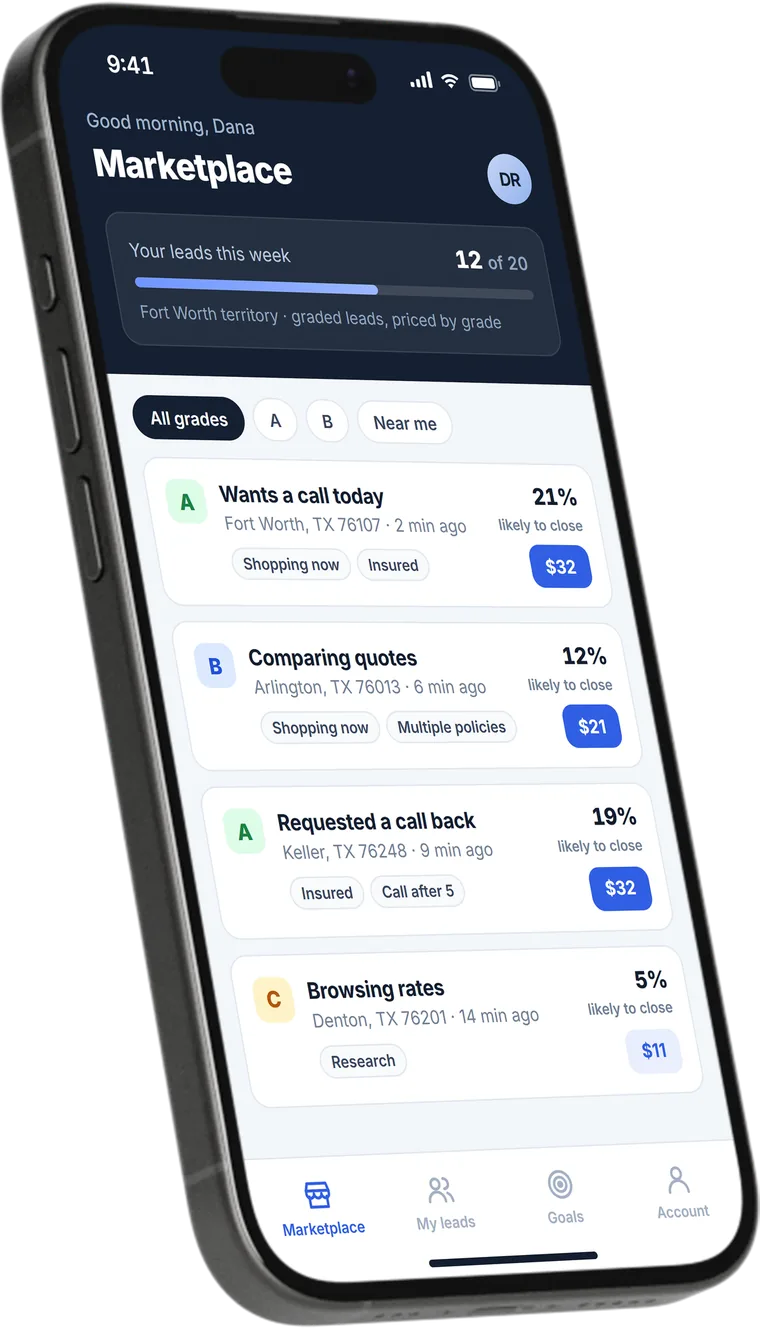
The lead marketplace on an iPhone: an agent’s list of graded leads in Fort Worth, each with its grade, how likely it is to close and its price

$2M+saved a year

The lead desk: every lead graded before the network bids

The challenge

A network bidding against itself

Buying internet leads had become a critical part of how the network’s agents found new customers. Each of its several hundred agents is contracted to the network but runs an independent business, including buying their own leads, and many bought from the same lead platforms. So when a promising lead came up for sale, several of the network’s own agents could be bidding on it at once, each bid raising the price for the next. Nobody was doing anything wrong, and nobody could see it happening.

Nobody could see which leads were worth the money, either. For years, agents had kept their lead invoices and receipts for taxes and advertising expenses: hundreds of thousands of purchases from dozens of vendors, spread across hundreds of separate businesses. The answer to “which leads actually turn into sales?” was in there, in dozens of vendors’ formats.

Most businesses with franchisees, dealers, branches or independent reps know a version of this: good people, working hard, and working against each other. To fix it, the network needed to:

  • Stop its own agents from bidding against each other, without taking away their independence.
  • Turn years of scattered invoices and receipts into one set of data.
  • Learn which leads actually become sales, and what each kind is worth.
  • Grade every new lead fast enough to bid on it in real time.
  • Buy only as many leads as its agents can work, and send them where they’re needed.
  • Give leadership one view of the whole funnel, from lead to sale, across every agent.

Before

Four of the network’s agents, one internet lead

One lead · Fort Worth, TX

  1. Agent 1$18
  2. Agent 2$24
  3. Agent 3$31
  4. Agent 4$41

Each bid raises the price for the next agent, and the vendor keeps the difference.

After

One network, one bid

One lead · Fort Worth, TX Graded B

  1. Network$19

Sent to one agent who needs leads this week

The lead is graded first, bought once at what it’s worth, then sent where it’s needed.

How a network ends up bidding against itself, and what one marketplace changed.

The approach

Four decisions that made it work

Every business has valuable data trapped somewhere: in filing cabinets, in scanned PDFs, in a system nobody wants to touch. This network’s was in its agents’ tax paperwork: years of receipts for leads they had bought, kept for tax time and filed away.

The most valuable data they had was filed under expenses.

AI can unlock data like that, but only when the software around it is built for the people who will use it: independent agents who run their own businesses and choose their own tools, and leaders who need to see the whole picture. A marketplace agents don’t want to use saves nobody anything. That’s product management, and it sits at the center of how we build. Each decision below maps to a problem your business probably has too.

01 · DATA

The gold mine was already in their receipts

We did the legwork. We collected the lead invoices and receipts from hundreds of agents across the country: hundreds of thousands of purchases from dozens of vendors, each vendor with its own paperwork. We digitized it and put it into one consistent shape.

Then we tied each lead to what happened next: did it become a sale? For the first time, the network could see which lead sources and campaigns actually drove revenue, and which were quietly wasting money.

Why it matters for your business

You’re probably sitting on data like this too: invoices, receipts, old spreadsheets, a CRM nobody trusts. It’s messy, which is why it gets ignored. Organized and tied to outcomes, it shows where your money works and where it doesn’t, and it becomes the foundation any AI you build will learn from.
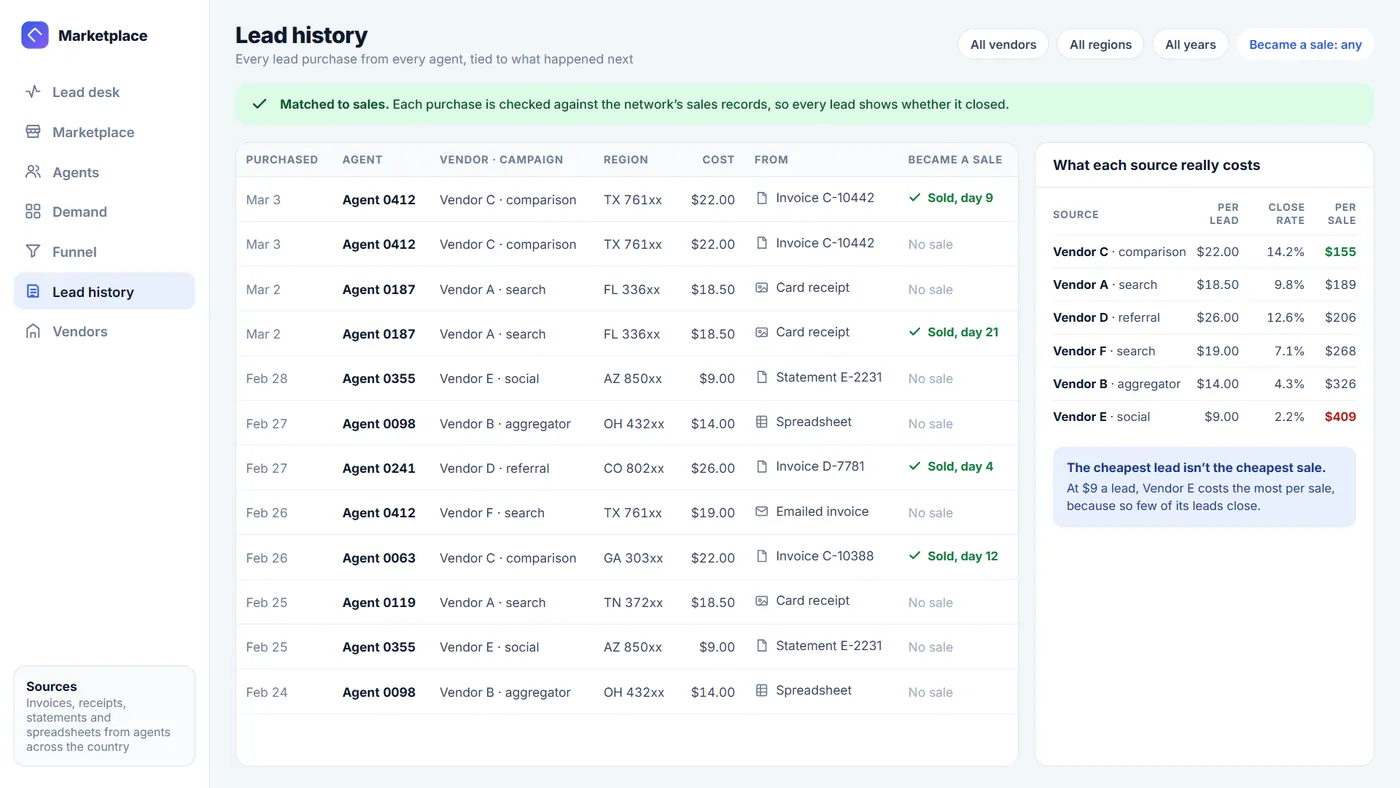
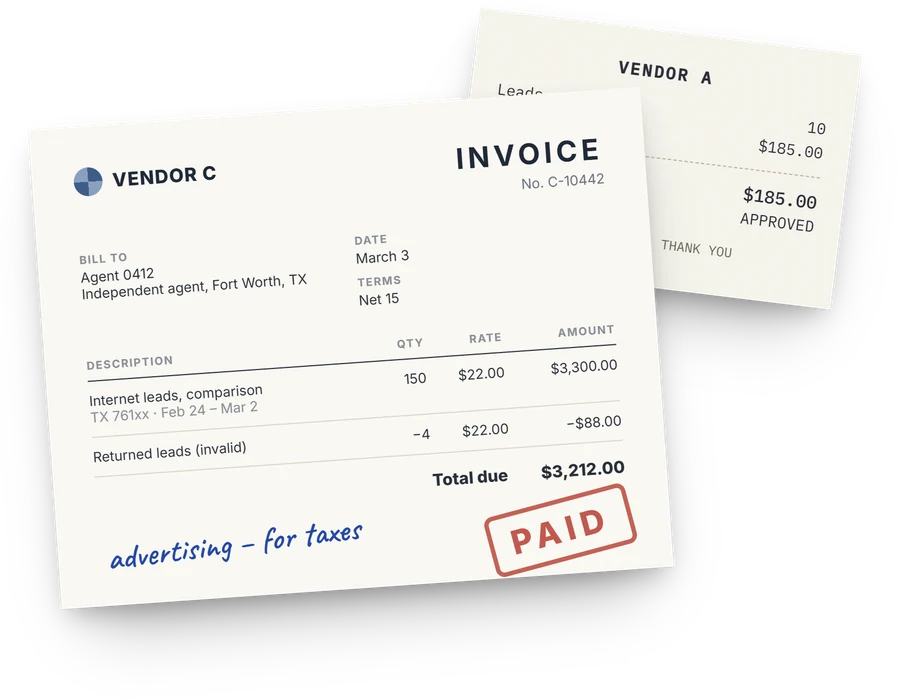
The lead history screen: a table of lead purchases by agent, vendor, region and cost, each linked to the invoice or receipt it came from and marked with whether it became a sale, beside a panel comparing what each source costs per lead and per sale A lead vendor’s paper invoice stamped paid, with a handwritten note reading advertising, for taxes, on top of a card receipt for ten leads
Invoices, receipts, statements and spreadsheets from hundreds of agents, turned into one lead history, with every purchase tied to whether it became a sale.
02 · ARTIFICIAL INTELLIGENCE

AI grades every lead before the network pays for it

With years of outcomes to learn from, we trained an AI model to grade leads. Every new lead gets a grade and a likelihood of becoming a sale the moment it’s offered, and the bid follows the grade: more for the kinds of leads that tend to close, less or nothing for the ones that don’t.

That changed how the network buys. Instead of competing blindly in an open market, every purchase became a data-backed decision about what a lead is likely to be worth, made in real time and the same way every time.

Why it matters for your business

AI is at its best making the same careful call thousands of times, consistently and faster than any person could. Pricing, bidding, approvals, which request to answer first: if your team makes a judgment call over and over, AI trained on your own history can often make it faster and more consistently, with your people setting the rules.

How a lead gets graded in five steps: offered, compared with history, graded, bought and routed. On-screen text, no sound needed.
03 · PRODUCT DESIGN

Agents stopped bidding against each other, and kept their independence

The second phase was a private marketplace for the network’s own agents. The network buys each lead once, at what it’s worth, and agents come to the marketplace for their leads instead of bidding against each other in the open market. They still run their own businesses and choose their own leads; they just no longer compete with their own colleagues to get them.

Independent agents are used to choosing their own tools; they’re contracted, not employed. So the marketplace had to earn its place with them, with a steady supply of graded leads and none of the bidding wars.

Why it matters for your business

If you have franchisees, dealers, branches or independent reps, they may be competing with each other for the same customers, leads or supplies, and you’re paying for it. The fix isn’t more control. It’s shared tools good enough that people choose to use them.
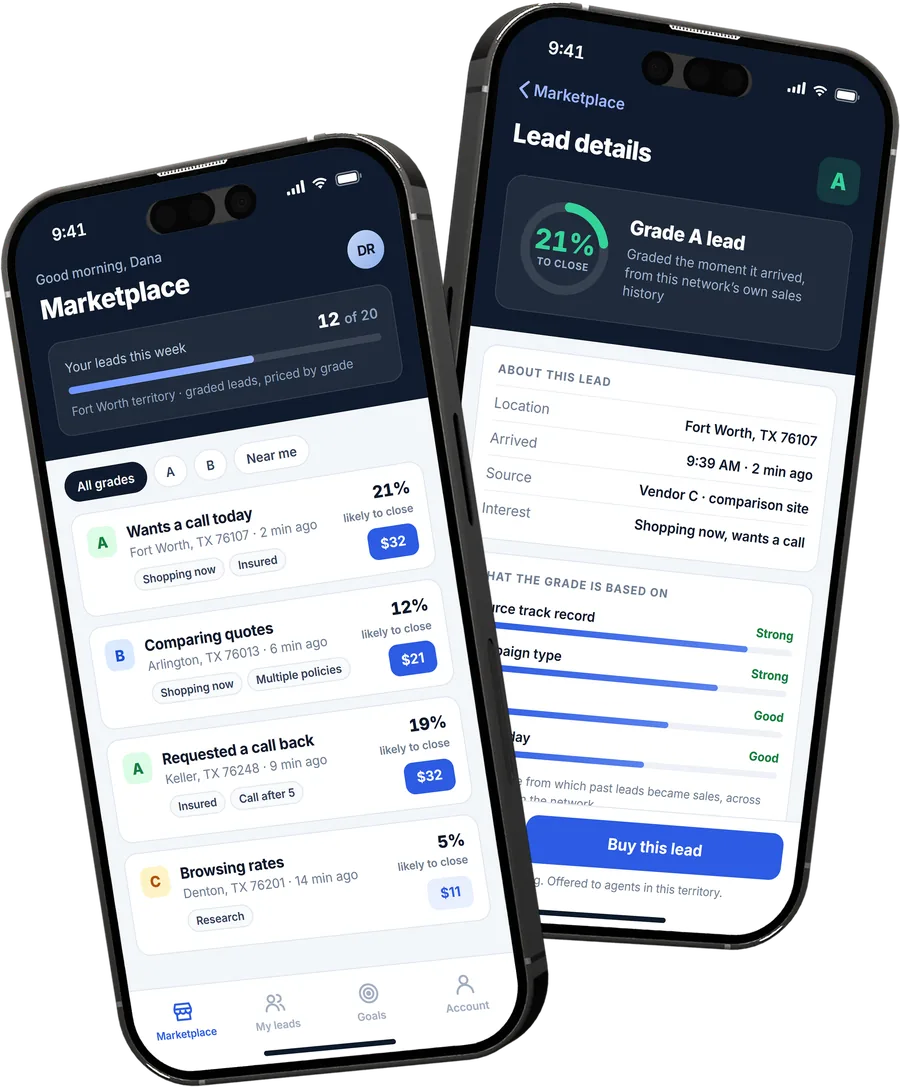
Two iPhones: in front, the marketplace with graded leads in the agent’s territory, each with how likely it is to close and its price; behind, a grade A lead’s details, with what its grade is based on and a button to buy it with no bidding
The agent’s side: graded leads in their territory, and what a lead’s grade is based on, before they buy.
04 · SUPPLY AND DEMAND

Buying what agents need, and sending it where it’s needed

Buying leads nobody has time to call is its own kind of waste. So the marketplace tells the buying model how many leads agents need, and where, before it bids. Leads are routed by demand, geography and performance, so a warm lead reaches an agent ready to call it, and the network keeps a steady flow of leads without overbuying.

Leadership got something it had never had: one view of the whole funnel, from the lead purchased to the sale, across every agent in the network.

Why it matters for your business

Matching supply to demand in real time is where a lot of money hides: inventory, staffing, dispatch, ad spend. When your systems share what’s needed and where, you stop paying for what nobody uses.
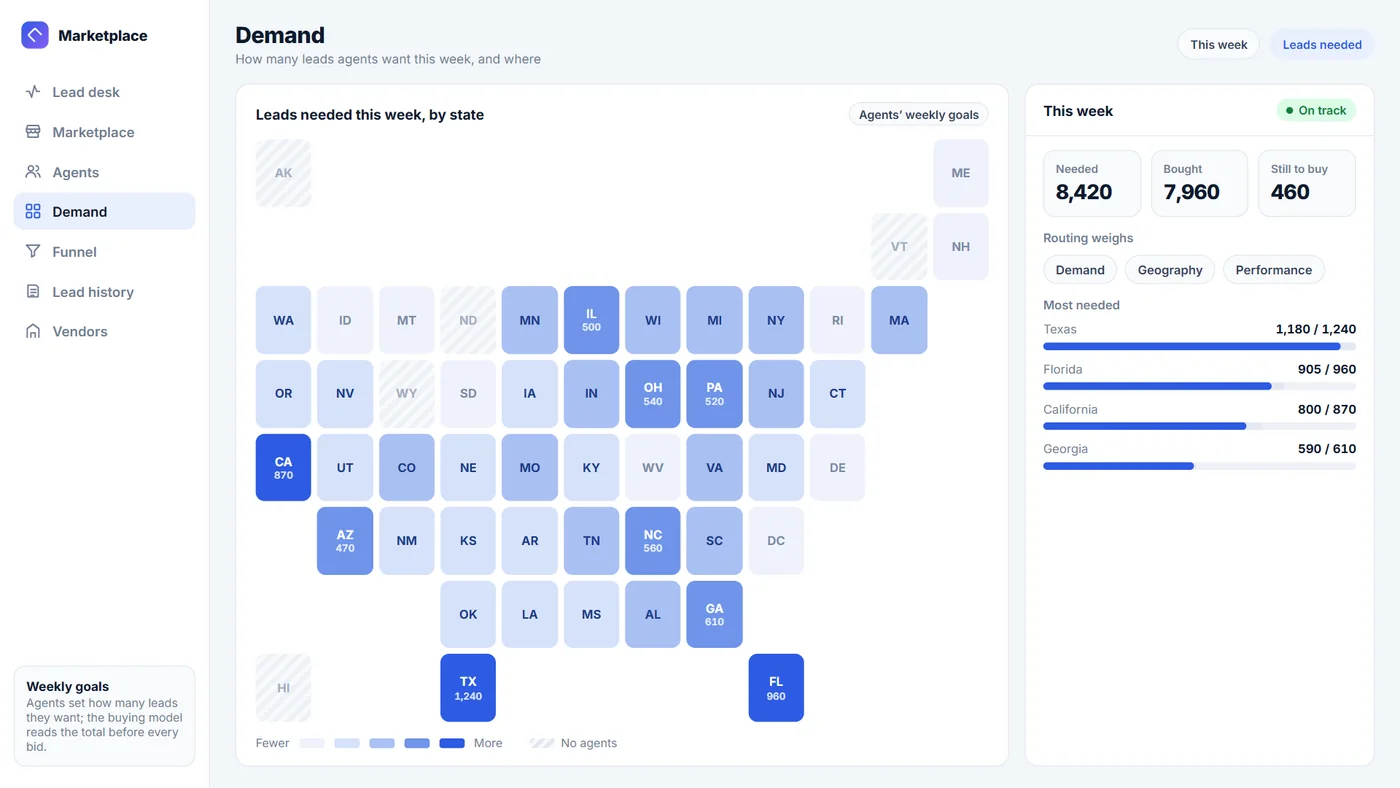
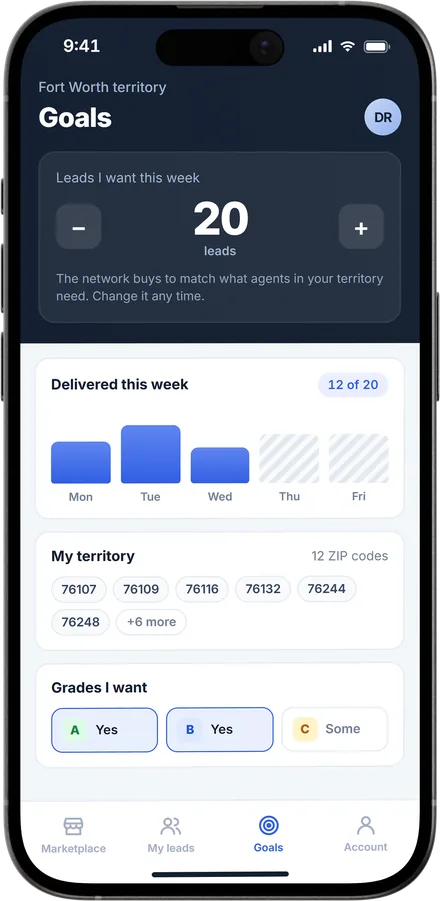
The demand screen: a map of the United States with one tile per state, shaded by how many leads agents want this week, beside totals for leads needed and bought and the states needing the most An agent’s weekly goal on an iPhone: 20 leads wanted this week, 12 delivered so far, their territory’s ZIP codes and the grades they want
Demand as the buying model sees it: how many leads agents want this week, state by state, and one agent’s weekly goal.

Why it matters for your business

What you get when we build your software

This network sells insurance, but the problems it solved are ones most businesses have: valuable data nobody has looked at, money spent without knowing what it returns, people competing when they should be pulling together, and supply that doesn’t match demand.

01

AI that finds the money in your paperwork

We gather the invoices, receipts and records you already have, put them into one shape and tie them to outcomes, so AI can learn what works in your business and what doesn’t. More on AI-powered business automation.

02

Every purchase a data-backed decision

Bidding, pricing, approvals and priorities, decided in real time from your own history, the same way every time and at the speed your business moves.

03

Your people pulling together, not against each other

Shared tools designed so independent teams, reps, dealers or franchisees choose to use them, because they make the work easier.

04

Supply matched to demand, and the whole funnel in view

Buy, stock and staff for what’s actually needed, and see every step from the first dollar spent to the closed sale.

Paying for leads, ads or inventory you can’t tie to a sale?

Tell us what you buy and what you wish you knew about it. The first conversation is about your business, not our technology.

The results

No more bidding wars. More than $2 million saved a year.

The network stopped bidding up its own leads, and started buying the leads that close.

  • Lead waste eliminated: acquisition costs fell sharply once agents stopped bidding against each other.
  • Record-setting sales years: better leads, reaching agents ready to work them.
  • The whole funnel in view, for the first time: every lead from purchase to sale, across every agent in the network.
  • Years of paperwork put to work: hundreds of thousands of old lead purchases became the data the AI learns from.
  • A steady flow of warm leads: the network buys to match what its agents need, where they need it.
  • Independence intact: agents still run their own businesses; they just stopped competing with each other.
The 40-second version, told in on-screen text, so it plays fine with the sound off.

Questions

Thinking about working with us?

We have years of invoices, receipts and spreadsheets. Is any of it worth anything?

Often more than you’d think. This network’s most valuable data was lead receipts its agents had kept for their taxes. Once we organized them and tied each purchase to whether it became a sale, they showed where the money was working, and they trained the AI that grades every new lead. Messy is normal; making it usable is our job.

How does AI decide what a lead, a customer or an order is worth?

It learns from your own history. We tie past records to their outcomes, such as which leads became sales or which jobs made money, train a model on that, and score new ones as they arrive. We measure its grades against real results, and your people set the rules it works within.

Our reps are independent. Will they actually use a central system?

They will if it’s better for them than what they do now, so that’s how we design it. This marketplace didn’t take away the agents’ independence; it ended the bidding wars and gave them a steady flow of graded leads. The same goes for dealers, franchisees and branch offices: we design around the people who have to choose to use the software.

Can you keep our name and our data confidential?

Yes. This network asked us not to name it, so we don’t, and nothing on this page identifies it. We’re glad to work under your NDA and your security requirements. For another confidential client, see our AI equipment valuation case study; for projects we can show in full, see the decks.app and Enslaved Texas case studies, or browse our portfolio.

We’re not a tech company. Can you still help us?

Yes. Most of our clients are mid-sized businesses, typically 50 to 500 employees, without a software team of their own. You bring the knowledge of your business; we turn it into software and explain every choice in plain English along the way.

How do we get started?

Tell us what you buy, sell or track, and what you wish you knew about it. The first conversation is about your business, not our technology. Contact us or call (817) 720-0273.

Salt Branch Technology Group · Fort Worth, Texas

Let’s find the money in your data.

Tell us what you buy, sell or track, and what you wish you knew about it. We’ll tell you what it takes to build it right, including where AI helps and where it doesn’t.